What it is
The cause is a long, thin, rod-shaped bacterium called Flavobacterium columnare. Scientists have recently split it into several closely related species, but they cause the same disease and farmers can treat them as one problem. These bacteria live naturally in most freshwater ponds, rivers, dams and on the fish themselves, so their presence alone does not mean disease. Trouble starts when fish are stressed or their protective skin slime (mucus) is damaged, for example by rough netting, crowding in transport tanks, low oxygen, high ammonia (a toxic waste from fish droppings and rotting feed) or warm water. The bacteria then stick to the skin, fins and gills, multiply and produce enzymes that break down tissue. On the skin this forms pale, dead patches that may become shallow ulcers. On the fins the edges rot away. On the gills, which are the organs fish use to breathe, the bacteria destroy the delicate gill filaments so the fish cannot take in enough oxygen or get rid of waste. Gill damage is often what kills the fish, sometimes before skin lesions are obvious. Damaged skin also lets water and salts leak in and out of the body and lets other germs in, so secondary infections with bacteria such as Aeromonas or water moulds are common.
Which animals are most at risk
All freshwater fish can be affected, but in Kenya the disease is most often seen in Nile tilapia, African catfish (Clarias, locally called kambare), rainbow trout in the cold-water farms of Central and Rift Valley highlands, and aquarium or ornamental fish such as goldfish and koi. Fry and fingerlings are the most vulnerable because their skin and gills are delicate, but adult brood fish also suffer after spawning or handling. Risk is highest just after stocking, transport, grading, harvesting part of a pond, or treatment baths. Warm conditions increase risk, so tilapia and catfish ponds in hot lowland areas, shallow ponds and tanks in direct sun, and trout farms during unusually warm spells are especially exposed. Intensive systems such as high-density tanks, recirculating systems and cages, as well as small backyard ponds that are overstocked, overfed or poorly aerated, see more outbreaks than well-managed, lightly stocked earthen ponds.
Signs to look for
Early signs
- Fish gather near the water inlet or at the surface and gulp air, especially in the early morning when oxygen is lowest.
- Fish eat less or stop coming to feed, and leftover pellets are seen in the pond.
- Small pale, greyish or whitish spots or patches appear on the skin, head, mouth or around the fins, sometimes with a yellowish tinge.
- Fin edges look frayed, white-edged or slightly eaten away, especially the tail and top fin.
- The body may look dull or covered in extra slime, and fish may rub against the pond sides or bottom.
- Gills, when gently checked on a caught fish, may have pale, whitish or brownish-yellow patches instead of a healthy deep red colour.
- A few fish die each day, often those that were handled most or are weakest.
As it gets worse
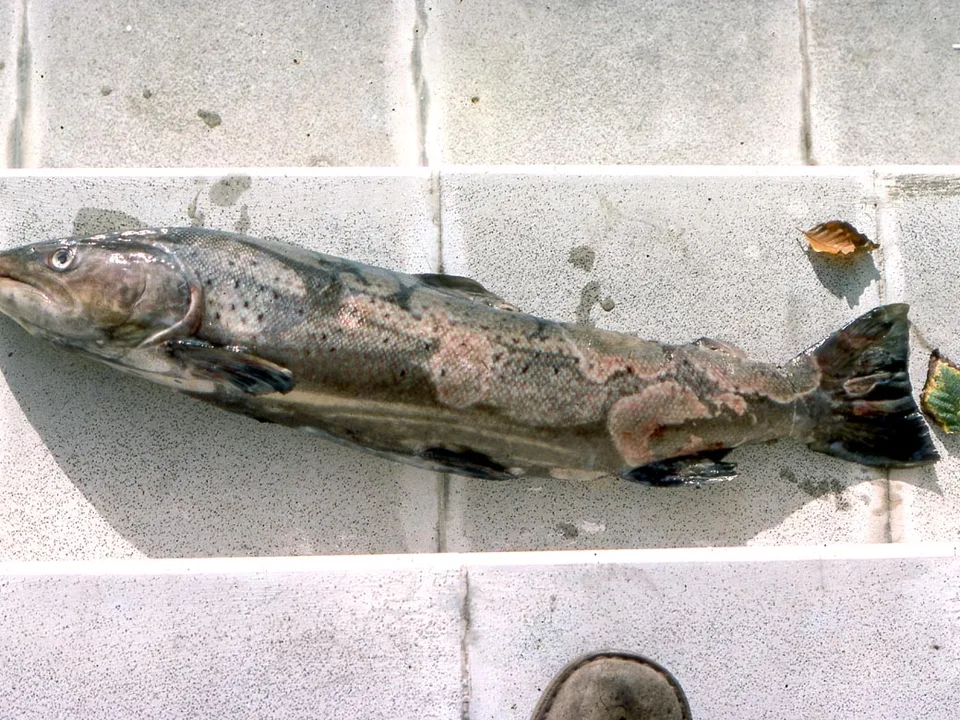
- A clear pale or grey band of damaged skin forms across the back behind the dorsal (top) fin, giving the classic saddle-back look.
- Patches turn into shallow, open sores with yellowish or orange edges, and scales may fall off around them.
- Fins are badly eroded down to the base, and the tail may be almost gone.
- White, fluffy-looking or cotton-like growth appears around the mouth and lips, which is why it is called cotton-mouth.
- Gills are badly eaten away, swollen or covered in yellow-brown debris, and fish breathe fast with flared gill covers.
- Fish become weak, swim slowly or lie near the edges, and lose balance.
- Deaths rise sharply over a few days, and in fingerlings a large part of the batch can be lost if nothing is changed.
What to do right now
- Stop all netting, grading, sorting, sampling and transport of fish from the affected pond or tank, because every handling makes the disease worse and spreads it.
- Improve oxygen immediately by running aerators or paddle wheels, increasing water flow, or adding fresh, clean, well-oxygenated water of a similar temperature to the pond.
- Test the water for oxygen, ammonia, nitrite, pH and temperature if you have a kit, and write the results down to share with the fisheries officer or vet.
- Reduce feeding or stop it for a day or two, since sick fish eat little and uneaten feed rots, lowers oxygen and raises ammonia.
- Provide shade over small ponds and tanks during hot weather, for example with shade net, to help keep the water cooler.
- Remove dead and dying fish at least once or twice a day, and bury them deeply with lime or burn them away from water sources, rather than throwing them into rivers or feeding them to other animals.
- Keep separate nets, buckets and boots for the sick pond, and wash and sun-dry or disinfect equipment before using it anywhere else on the farm.
- Do not move fish from the sick pond into other ponds and do not sell or give away live fish until the problem is under control.
- Record daily deaths, feeding, water results and any changes in behaviour, and call your County Fisheries Officer or a fish vet for advice before using any chemical or medicine.
How it spreads
- Handling, netting, grading, sorting and transporting fish rub off the protective mucus and are the most common trigger, with disease often showing two to five days later.
- The bacteria pass from fish to fish through the water, so one sick fish in a crowded tank or pond can quickly infect the rest.
- Dead and dying fish left in the water release large numbers of bacteria and should be seen as a major source of infection.
- Shared nets, buckets, hapas, transport tanks and boots carry the bacteria from one pond to another when they are not cleaned and dried.
- Buying in fingerlings from a hatchery with poor hygiene, or mixing new fish with your stock without quarantine, can bring in the disease.
- Warm water, especially in the hot dry months before the long rains and in shallow ponds or plastic-lined tanks in full sun, favours fast growth of the bacteria.
- Poor water quality such as low dissolved oxygen, high ammonia or nitrite, heavy algae die-off, muddy water after heavy rain and overfeeding all weaken fish and make outbreaks more likely.
- Water flowing from an infected pond into others, or from rivers and dams with wild fish, can carry the bacteria onto the farm.
Could it be something else?
Water mould (Saprolegnia, fungal infection)
Water mould forms soft, fluffy, cotton-wool tufts that float out in the water and are usually pure white or turn brown-green as they trap dirt. Columnaris patches are flatter, greyer or yellowish and lie on the skin rather than standing out as long fibres. The two often occur together, so a vet or fisheries officer using a microscope is the reliable way to tell them apart.
White spot disease (Ich, Ichthyophthirius parasite)
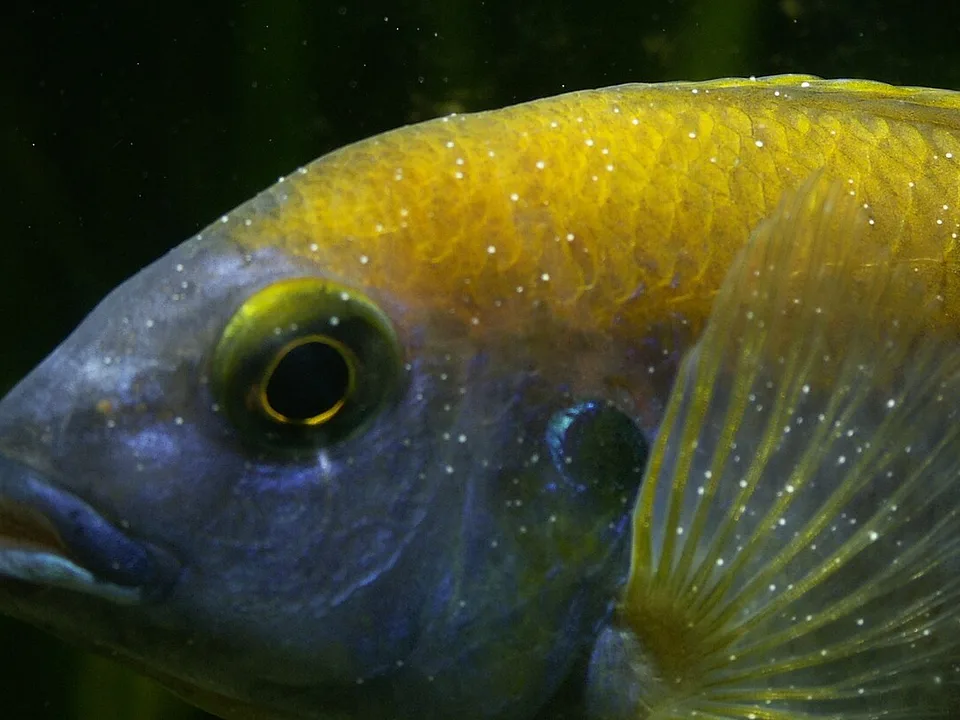
White spot shows as many tiny, separate white dots like grains of salt or sugar scattered over the body and fins. Columnaris causes larger, spreading patches, saddle-shaped bands and rotting fins rather than neat pinhead spots.
Motile Aeromonas septicaemia (red sore or haemorrhagic disease)
Aeromonas infection usually causes red, bloody-looking ulcers, red streaks on fins and belly, a swollen belly and bulging eyes. Columnaris lesions are mainly pale, grey or yellowish with eroded fins and gills. Aeromonas can also invade columnaris sores, so mixed signs are possible and lab tests help.
Water quality problems (low oxygen, ammonia or nitrite poisoning)
When the water itself is the problem, many fish of all sizes gasp at the surface at once, often at dawn or after an algae crash, and there may be no skin patches at all. Columnaris usually starts in a few fish with visible skin, fin or gill lesions and spreads over days. Testing the water with a simple kit settles the question, and poor water can trigger columnaris, so both may be present.
How it is diagnosed
A vet, fisheries officer or aquaculture laboratory usually starts by asking about recent handling, stocking, transport, feeding and water temperature, and by watching how the fish behave in the pond. They then catch a few sick but still living fish and look closely at the skin, fins and gills. The quickest test is a wet mount: a small scraping of slime or gill tissue is put on a glass slide and looked at under a microscope. Columnaris bacteria appear as long, thin, gliding rods that gather into characteristic columns or haystack-like clumps, which gives the disease its name. To confirm, samples can be grown on special low-nutrient culture plates, where the bacteria form yellowish, spreading colonies, and some laboratories use PCR (a test that detects the germ's genetic material) to identify the exact species. Labs may also test which antibiotics will work, which is important for responsible use. Water will be tested for temperature, dissolved oxygen, ammonia, nitrite and pH. In Kenya, help can be sought from your County Fisheries or Veterinary Officer, the Kenya Fisheries Service, KMFRI aquaculture research centres such as Sagana, and university or government veterinary laboratories. To prepare, keep a written record of when signs began, daily deaths, feeding, recent handling or new stock and any treatments used. Have five or more live, sick fish ready in a clean bucket of pond water with an air stone if possible, because fish that have been dead for hours are of little use for testing. Note water test results and the source of your fingerlings.
Treatment
Treatment of columnaris always begins with fixing the underlying stress, because the bacteria are already present in most water and the disease returns if conditions stay poor. A vet or fisheries officer will usually advise better aeration, partial water changes, lower stocking density, reduced feeding, removal of organic waste and, where possible, cooler water. Depending on the species, the system and what is legally available, they may advise external treatments such as baths or dips using salt, potassium permanganate or hydrogen peroxide to reduce bacteria on the skin and gills. These chemicals can easily harm or kill fish if the strength, water quality or timing is wrong, and some species, especially catfish and fry, are very sensitive, so they must only be used under professional guidance and never by guesswork. In severe or spreading outbreaks, a vet may prescribe antibiotics mixed into feed, such as oxytetracycline or florfenicol, where these are registered for fish. Medicated feed only works if fish are still eating, so it is most useful early in an outbreak. Antibiotics must be prescribed by a vet, ideally after a lab test shows which drug will work, and the full course must be followed. Using antibiotics casually in ponds wastes money, pollutes the water, harms beneficial bacteria and builds antimicrobial resistance, where medicines stop working for fish and people. Any drug used has a withdrawal period, a set time during which treated fish must not be harvested or sold for food, and this must be strictly respected. Farmers should expect losses to slow within days once water quality improves and treatment starts, but some badly damaged fish will still die, and survivors need time and good conditions to heal their skin and fins.
Medicines must be prescribed and dosed by a vet. Always respect milk and meat withdrawal periods, and finish the full course of any antibiotic.
Prevention
- Handle fish as little and as gently as possible, use soft knotless nets, keep fish in water rather than in the air, and avoid grading or moving them during the hottest part of the day or season.
- Before and after transport or stocking, give fish clean, well-aerated water, avoid overcrowding in transport containers and allow them to settle without feeding heavily for the first day.
- Keep stocking density within what your pond, tank or cage and aeration can support, as advised by your fisheries extension officer.
- Maintain good water quality by testing regularly, using aeration where needed, exchanging water, removing sludge between cycles and avoiding sudden changes in temperature or pH.
- Feed a good-quality, correctly sized fish feed in amounts the fish clear within a few minutes, and store feed dry and cool so it does not go mouldy or lose vitamins, which weakens immunity.
- Buy fingerlings only from certified, reputable hatcheries, ask about their disease history, and quarantine new fish in a separate tank for observation before mixing them with your stock.
- Keep separate equipment for each pond or disinfect nets, buckets and hapas between uses, and dry ponds and treat them with agricultural lime between production cycles.
- Provide shade or deeper water in hot areas, and plan harvesting, grading and restocking for cooler months or early mornings.
- Remove dead fish every day, keep records of deaths and water quality, and act early when you notice fish gasping, off-feed or showing pale patches.
Risk to people
Columnaris is not considered a disease that infects people, and properly cooked fish from an affected pond is not known to cause the illness in humans. However, sick and dying fish often carry other germs, so wear gloves or wash hands well with soap after handling them and cover any cuts on your hands. Do not eat or sell fish that died of disease. If your fish have been treated with antibiotics or chemicals, strictly follow the withdrawal period given by the vet before harvesting, eating or selling them, because drug residues in fish meat can harm consumers and contribute to antimicrobial resistance.
Impact on your farm
Columnaris can cause heavy losses on Kenyan fish farms, especially among fingerlings just after stocking, which means farmers lose the money spent on seed, transport and early feed. Even when deaths are moderate, sick fish stop eating and grow slowly, so harvests are delayed and fish reach market below the expected size. Scarred, fin-damaged fish fetch lower prices or may be rejected by buyers, hotels and supermarkets that want clean-looking fish. Treatment, extra aeration, water pumping and lab tests add cost, and where antibiotics are used, the withdrawal period can delay sales. Hatcheries that suffer repeated outbreaks lose customers and reputation. For smallholders who joined fish farming through county or national programmes, a single bad outbreak can wipe out a season's profit, which is why prevention through gentle handling and good water management pays off.
Outlook and recovery
The outlook depends mostly on how early the problem is spotted and how quickly the stress behind it is corrected. When water quality, oxygen and crowding are fixed early and professional treatment follows, losses often slow down within days and most fish recover, with fins and skin regrowing over the following weeks. Outbreaks in fry and fingerlings, those with severe gill damage, and those in very warm or badly polluted water carry a poorer outlook, and many affected fish may die. Fish that survive can carry the bacteria and remain at risk of relapse if stressed again, so continued good management is essential. Repeated outbreaks on the same farm are a sign that handling, stocking density or water management needs to change.
Common questions
Why do my fish get sick a few days after I move or sort them?
Netting and handling rub off the protective slime layer and cause tiny injuries to the skin and gills, and crowding during transport adds stress and lowers oxygen. Columnaris bacteria already live in most ponds and take advantage of this damage, so signs often appear two to five days later. Gentle handling, moving fish in cool parts of the day, avoiding overcrowded containers and giving clean, well-aerated water afterwards greatly reduce the risk.
Is this the same as fungus on my fish?
Not exactly. Columnaris is a bacterial disease that causes flat grey, white or yellowish patches, saddle-shaped bands and rotting fins and gills. True fungus, more correctly a water mould called Saprolegnia, forms long fluffy cotton-like tufts. The two can look alike and often appear together because water mould grows on damaged skin. A quick microscope check by a fisheries officer or vet tells them apart, and the right treatment differs, so it is worth getting it confirmed.
Can I just add antibiotics from the agrovet to the pond water?
No. Pouring antibiotics into pond water is wasteful, rarely reaches the right level to work, pollutes the environment and kills useful bacteria in the pond. It also builds antimicrobial resistance, so medicines stop working in future for fish, livestock and people. If antibiotics are needed, a vet will prescribe a suitable product, usually in feed, and tell you the withdrawal period before the fish can be eaten or sold. Fixing water quality and stress is always the first and most important step.
Is salt safe to use for columnaris?
Salt baths are a common treatment for many freshwater fish and can help reduce bacteria on the skin and support the fish's salt balance. But the correct strength and time vary with species, fish size and water conditions, and catfish, fry and some ornamental fish can be harmed by the wrong strength. Ask your fisheries officer or a fish vet to guide you, test on a few fish first if advised, and always watch fish closely during any bath.
Can I eat or sell fish from a pond with columnaris?
Columnaris is not known to infect people, so healthy-looking fish from the pond that have not received any medicine can be eaten after proper cleaning and cooking. Do not eat or sell fish that died of disease or look badly diseased, as other germs may be present and buyers will reject them. If any antibiotic or chemical treatment was used, you must wait the full withdrawal period your vet gives before harvesting for food.
Will the disease come back after the outbreak ends?
It can. The bacteria stay in the water and on surviving fish, so any new stress such as hot weather, overcrowding, low oxygen or rough handling can trigger another outbreak. Between cycles, drain and dry the pond, remove sludge and apply agricultural lime, clean all equipment, buy fingerlings from a reliable hatchery and keep stocking and feeding at sensible levels. Regular water testing and gentle handling are the best protection.
A guide, not a diagnosis. This page is general information to help you recognise problems early. Always confirm with a vet or animal health worker before treating.