What it is
Saprolegnia is a water mould. It looks and behaves like a fungus, but scientists class it as an oomycete, a separate group of organisms. It lives naturally in almost all fresh water, ponds, rivers and tanks, feeding on dead plant and animal matter. Healthy fish are protected by a layer of slime (mucus) and intact skin and scales, so the mould usually cannot get a hold. When that protective layer is damaged, for example by netting, rough handling, fighting, bird attacks, parasites, bacterial sores or poor water, the mould's tiny swimming spores settle on the damaged spot and germinate. They grow fine threads (called hyphae) that spread across the skin and push into the flesh underneath. This destroys the skin surface, so the fish loses body salts and takes in too much water, which upsets its internal balance. If the gills are affected, the fish struggles to breathe. On eggs, the mould first grows on dead or unfertilised eggs, then its threads spread out and smother nearby healthy eggs, cutting off oxygen. Cool water favours the mould and also slows the fish's immune system, which is why the problem peaks when temperatures drop.
Which animals are most at risk
Fish eggs and newly hatched fry in hatcheries are at the highest risk, especially catfish and trout eggs incubated in trays or jars where dead eggs are not removed. Rainbow trout farmed in the cold highland rivers around Mount Kenya, the Aberdares and parts of the Rift Valley are very susceptible because their water is cool all year. Nile tilapia and African catfish in ponds are mostly affected during the cold season, in high-altitude counties, and after handling, transport or stocking. Broodstock after spawning, fingerlings just delivered from a hatchery, and fish in overstocked or poorly managed ponds and tanks are all more likely to suffer. Farms with muddy, unmanaged ponds, little water exchange, overfeeding, or frequent harvesting and sorting see more cases.
Signs to look for
Early signs
- Small white or grey fluffy spots, like a thin layer of cotton wool, appear on the skin, fins, tail or around the mouth and eyes.
- The fluffy growth often starts at the edge of a wound, a damaged fin or a spot where scales have been lost after netting.
- When the fish is lifted out of water the tufts collapse into a slimy, flat, greyish film, then fluff up again when put back.
- Affected fish may rub against the pond sides or bottom and swim alone near the edges or the water inlet.
- Fish eat less than usual and react slowly when feed is thrown in.
- In hatchery trays or jars, dead eggs turn opaque white and develop a fine fuzzy halo of threads around them.
As it gets worse
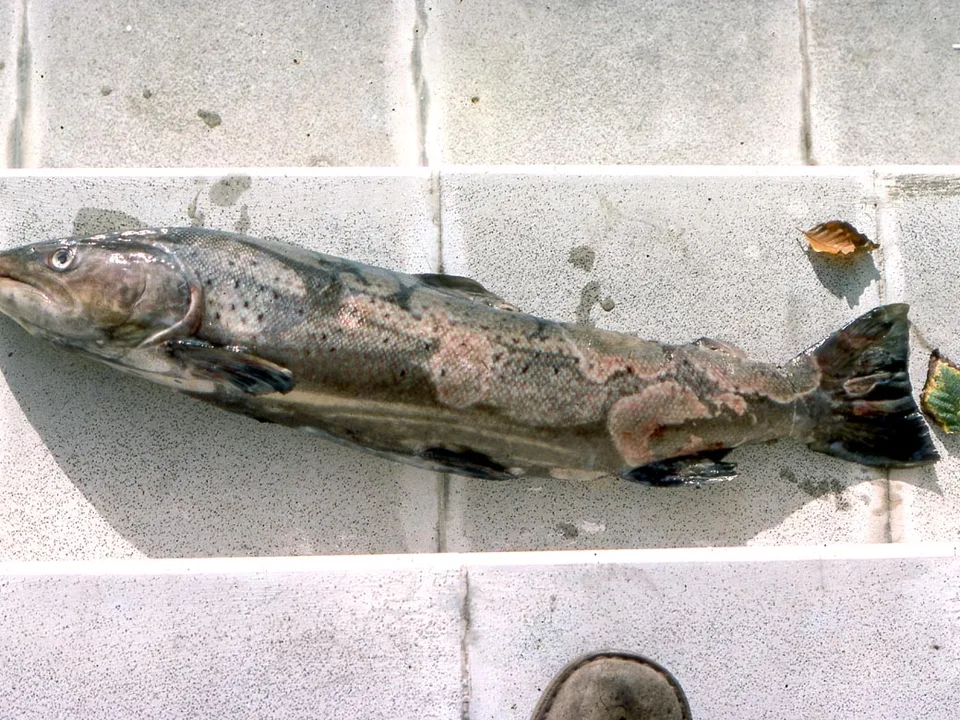
- The patches spread and join into large areas covering the body, head or gills, sometimes looking like a woolly coat.
- Older tufts turn brown, grey or greenish because they trap mud, algae and debris.
- Fins become ragged and eroded, and pale or reddish sores appear under the mould when it comes away.
- Infected gills look pale and clogged with fluffy growth, and the fish gasps at the surface.
- Fish lose balance, lie on their side, stop feeding completely and become thin.
- Deaths increase over several days, usually among fish that were already injured or weak.
- In hatcheries, mould threads join eggs together into fuzzy mats, and healthy eggs inside the clump die.
What to do right now
- Remove all dead and dying fish and all dead or mouldy eggs at once, and bury them away from the water or dispose of them as your fisheries officer advises; never throw them back into a pond or stream.
- Stop all netting, sorting, grading and transport of the affected fish unless absolutely necessary, because every handling causes new skin damage.
- Check water quality: improve aeration or water flow to raise oxygen, stop overfeeding, and remove uneaten feed and excess debris from tanks and ponds.
- Where you can, move badly affected fish into a separate tank or hapa (net cage) so they do not shed huge numbers of spores into the main pond.
- Reduce feeding to what the fish actually eat within a few minutes, as uneaten feed rots and worsens water quality.
- Clean and disinfect nets, buckets, hatchery trays and other equipment, and use separate equipment for affected units.
- Record daily deaths, water temperature and what you have observed, and take photos to show the expert.
- Contact your County Fisheries Officer, a vet with fish experience or your hatchery supplier for advice before using any salt bath or chemical, as the right product and strength depend on the fish species, size and water.
How it spreads
- Spores are already present in almost all fresh water, so the disease is triggered mainly by injury and stress rather than simply 'caught' from another farm.
- Rough handling during netting, sorting, grading, weighing or transport scrapes off slime and scales and creates entry points for the mould.
- Sudden drops in water temperature, such as during the cold season (roughly June to August) or when cold rain or borehole water floods a pond, weaken the fish and favour mould growth.
- Dead fish and dead or unfertilised eggs left in the water grow large amounts of mould and release huge numbers of spores that then attack live fish and eggs.
- Poor water quality, including low oxygen, high ammonia from overfeeding or overstocking, and dirty water full of organic matter, stresses fish and feeds the mould.
- Wounds from fighting, cannibalism in catfish, predator birds, otters, monitor lizards and parasites such as anchor worm or lice open the skin for infection.
- Spawning stress and hormone-induced breeding leave broodstock thin-skinned and run-down, so they often develop mould after stripping.
- Contaminated nets, buckets, hatchery trays and water shared between tanks can carry spores and infected material from one unit to another.
Could it be something else?
Columnaris (bacterial 'cotton wool' or saddleback disease)
Columnaris is caused by bacteria, not mould. Patches are usually flatter, yellowish-white or greyish and often form a band across the back (a 'saddle'), with mouth and gill rot. It is more common in warm water, while Saprolegnia favours cool water. Under a microscope, a vet or fisheries officer sees bacteria instead of the long branching threads of mould, and the two are treated differently.
White spot (Ich, Ichthyophthirius)
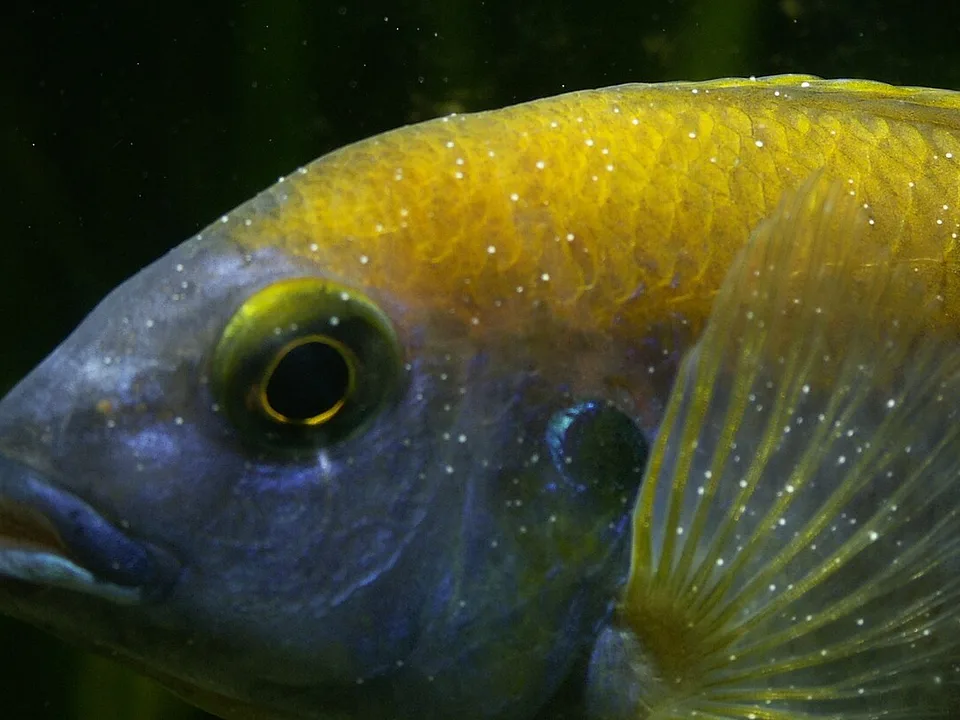
White spot shows as many small, separate, pinhead-sized white dots scattered over the body and fins, like grains of salt or sugar. There is no fluffy, hairy growth. Saprolegnia forms larger soft tufts, usually starting at a wound.
Excess mucus from poor water or parasites
Fish irritated by ammonia, low pH or skin parasites may produce a cloudy, greyish slime layer over the whole body. This film is smooth and not fluffy, and it does not form cotton-like threads in the water. A skin scraping under a microscope helps tell them apart.
Dead or unfertilised eggs without mould
Dead eggs turn white and opaque but at first are smooth and clean. Only when Saprolegnia grows on them do they get a fuzzy halo of fine threads. Both should be removed quickly, because clean dead eggs soon become mouldy.
How it is diagnosed
A vet, County Fisheries Officer or aquaculture specialist usually suspects Saprolegnia from the typical cotton-wool appearance, the cool season and a recent history of handling, transport or spawning. To confirm, they take a small sample of the fluffy material or a skin scraping and look at it under a microscope: water mould shows long, branching threads without cross-walls, often with spore sacs at the tips. This also rules out bacteria such as columnaris and parasites, which often occur at the same time. Samples may be sent to a laboratory such as a county veterinary lab or KMFRI (Kenya Marine and Fisheries Research Institute) for culture and to identify secondary bacterial infection. The officer will also test water quality, especially temperature, dissolved oxygen, ammonia and pH, because poor water is often the real root cause. To help, the farmer should keep a few live affected fish in a bucket of pond water, keep a record of when deaths started, how many fish have died each day, recent handling or stocking, feeding amounts, water source and any changes in weather, and, if possible, take clear photos of the affected fish and eggs.
Treatment
Treatment focuses on killing or slowing the mould on the fish or eggs and, more importantly, fixing the stress that allowed it to grow. Expert advice is essential, and any chemical treatment should be chosen and prescribed by a vet or qualified fisheries officer. A common first approach for table fish is a salt (sodium chloride) bath or longer exposure to salt in the water, which helps fish keep their body salt balance and discourages mould; the correct strength and time differ greatly between tilapia, catfish and trout, so it must not be guessed. For hatchery eggs and some fish, approved disinfectants such as hydrogen peroxide, and in some places formalin or bronopol-based products, may be used as short baths under strict guidance, since too strong a dose can kill eggs and fish. Malachite green was once widely used but is banned for food fish in many countries because it leaves harmful residues, and it should not be used on fish meant for eating. Antibiotics do not kill water moulds and will not cure Saprolegnia; they are only considered if a vet confirms a bacterial infection alongside the mould, and must be used responsibly to avoid antimicrobial resistance. Where any drug or chemical is used, the vet will give a withdrawal period, a time during which treated fish must not be harvested or sold for food. Fish with mild, early patches often recover once handling stops and water improves, while fish with heavy gill or whole-body infection may not survive and are best removed.
Medicines must be prescribed and dosed by a vet. Always respect milk and meat withdrawal periods, and finish the full course of any antibiotic.
Prevention
- Handle fish as little and as gently as possible: use soft, knotless nets, wet your hands, keep fish in water during sorting and avoid crowding them in buckets or nets.
- Keep good water quality by not overstocking, feeding only what fish eat, maintaining aeration or water flow, and checking oxygen, ammonia and temperature regularly where you can.
- Remove dead fish daily and, in hatcheries, remove dead and unfertilised eggs at least once a day using a soft tool or pipette.
- In hatcheries, use clean, well-oxygenated water, keep egg trays and jars clean, and ask your hatchery adviser about approved routine egg disinfection.
- Plan handling, harvesting, grading and transport for warmer parts of the day and avoid them in the coldest weeks when possible.
- Avoid sudden temperature changes by acclimatising new fish slowly and protecting ponds from large inflows of cold rain or borehole water.
- Quarantine new fingerlings or broodstock in a separate tank for a period before mixing them with your stock, and buy only from reputable certified hatcheries.
- Feed a good-quality, balanced fish feed stored dry and away from heat to keep fish strong, and separate catfish by size to reduce biting.
- Control predators such as birds and otters with netting or bird lines, and treat skin parasites early with expert advice so wounds do not form.
- Between production cycles, drain, dry and lime ponds where appropriate, and regularly clean and disinfect nets, tanks and equipment.
Risk to people
Saprolegnia water mould is not known to infect people, so normal handling of affected fish carries no direct infection risk; washing hands after handling fish and pond water is still good hygiene. The main human concern comes from the chemicals used to treat fish. Some products, such as formalin and strong hydrogen peroxide, irritate skin, eyes and lungs, so wear gloves and eye protection and use them only in well-ventilated areas as instructed. Fish treated with any chemical must not be harvested or sold before the withdrawal period given by the vet or fisheries officer has passed, and banned products such as malachite green must never be used on food fish because they can leave harmful residues.
Impact on your farm
On a Kenyan fish farm, Saprolegnia can cause serious losses in hatcheries, where whole batches of catfish, tilapia or trout eggs can be lost if dead eggs are not removed, cutting fingerling supply and income. In grow-out ponds and tanks, deaths after handling, transport or stocking reduce the number of fish that reach market size. Sick fish stop feeding and grow slowly, so the farmer spends more on feed for less weight gained. Fish with mould patches, sores and ragged fins look unattractive and may be rejected or fetch lower prices at local markets and hotels. Broodstock losses after spawning are expensive because good breeding fish take time and money to replace. There are also extra costs for treatment, labour and expert visits, and repeated outbreaks can damage a hatchery's reputation with customers.
Outlook and recovery
The outlook depends on how early the problem is noticed, how much of the fish is covered and whether the underlying cause is fixed. Fish with small patches on the skin or fins often recover once handling stops, water quality improves and temperatures rise, sometimes with the help of expert-guided salt or disinfectant treatment. Fish with heavy infection of the gills, head or large parts of the body, or with deep sores and bacterial infection, often die even with treatment. Eggs that are already covered in mould cannot be saved, but the rest of the batch can be protected by removing dead eggs quickly. Because the mould is always present in water, outbreaks will return unless handling, water quality and hatchery hygiene are improved.
Common questions
Is this the same as 'cotton wool disease'?
Farmers often use 'cotton wool disease' for any fluffy white growth on fish, but two different problems can look similar. Saprolegnia is a water mould that forms soft, hairy tufts, usually in cool water and on wounds. Columnaris is a bacterial disease that forms flatter, yellowish-white patches, often in warm water. They are treated differently, so it is worth having a fisheries officer or vet check a sample under a microscope.
Can I eat or sell fish that had this mould?
The mould itself is not known to harm people, but badly affected fish look poor and should not be sold. Dead or dying fish should be removed and disposed of properly, not sold. If fish have been treated with any chemical, you must wait for the full withdrawal period advised by the vet or fisheries officer before harvesting or selling them for food.
Can I just add salt to the pond to cure it?
Salt is commonly used to help fish with water mould, but it is not a guaranteed cure and the right amount depends on the fish species, size and whether it is a short bath or a whole pond. Too much salt can kill fish, especially catfish and trout, and salting a large earthen pond can be costly and harmful to plants. Always ask your County Fisheries Officer or a vet for the correct method before using salt, and fix handling and water problems at the same time.
Why does it appear mostly in the cold season?
Saprolegnia grows well in cool water, while fish like tilapia and catfish become sluggish and their immune defences slow down when water is cold. In Kenya this often happens around June to August and in highland counties. Trout farms have cool water all year, so they must be careful all the time. Avoiding handling during the coldest weeks and keeping water clean reduces the risk.
Should I use antibiotics?
No, not on your own. Antibiotics do not kill water moulds, so they will not cure Saprolegnia. A vet may only prescribe an antibiotic if tests show a bacterial infection as well. Using antibiotics without need wastes money, can leave residues in fish meant for food, and helps create resistant bacteria that are harder to treat in future.
Will it spread to my other ponds?
The mould spores are already present in most fresh water, so the disease is mostly triggered by stress and injury. However, dead fish, mouldy eggs and dirty equipment release huge numbers of spores and can increase infection in other units. Removing dead fish and eggs quickly, using separate or disinfected nets and buckets, and not moving sick fish between ponds helps protect the rest of your farm.
A guide, not a diagnosis. This page is general information to help you recognise problems early. Always confirm with a vet or animal health worker before treating.