What it is
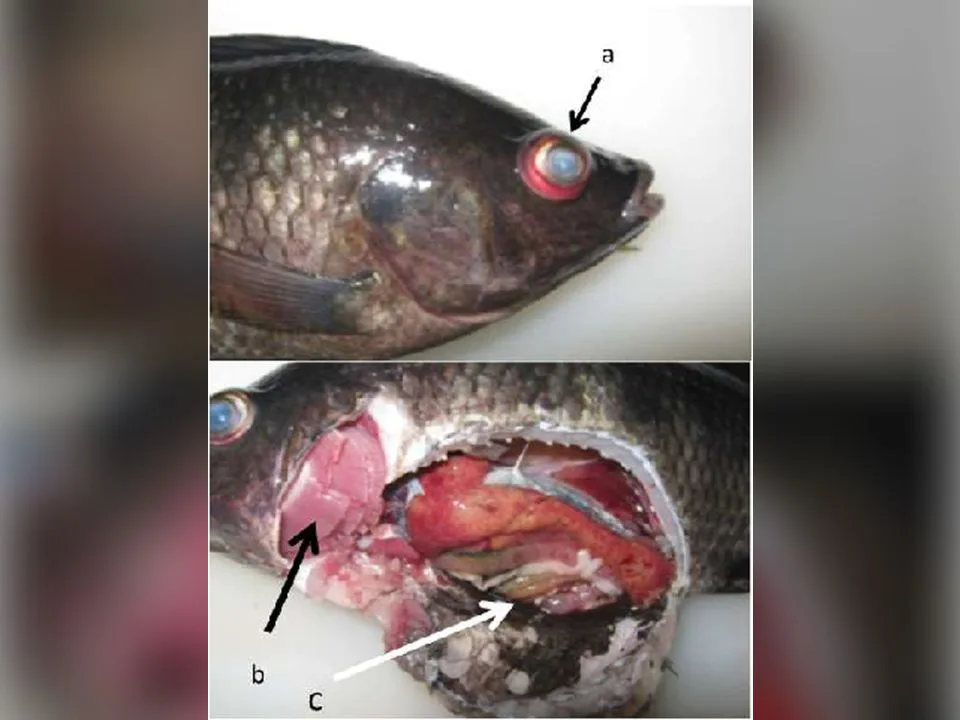
The disease is caused by Streptococcus bacteria, mainly Streptococcus agalactiae (sometimes called Group B Strep) and Streptococcus iniae. These bacteria can live in pond water, mud and in apparently healthy carrier fish without causing obvious problems. When fish are stressed, for example by hot water, low oxygen, high ammonia from too much feed and waste, overcrowding or rough handling, their defences weaken and the bacteria enter the body, usually through the gut, gills or small skin wounds. Once in the blood (septicaemia means bacteria spreading in the blood), they multiply and travel to the brain, eyes, kidney, spleen and heart. Infection of the brain and its covering (meningoencephalitis) is what causes the spinning, circling and loss of balance. Infection inside and behind the eye causes fluid and swelling, so the eye bulges out (exophthalmia, or pop-eye) and the cornea turns cloudy. Fluid may also build up in the belly, making it look swollen. Some outbreaks are sudden with many deaths; others are slow, with a few fish dying every day for weeks.
Which animals are most at risk
Nile tilapia (Oreochromis niloticus) and other tilapia species are most at risk, along with some other warm-water fish. In Kenya and East Africa the highest risk is in intensive systems: cage farms on Lake Victoria and large dams, heavily stocked liner and concrete ponds, and recirculating tanks, where many fish share the same water. Streptococcus agalactiae often strikes larger, fast-growing fish (from fingerling grow-out up to market size), while Streptococcus iniae can also affect younger fish. Outbreaks are most common in the hot, dry months before the long rains and during any spell of hot, still weather, when water warms up and oxygen falls. Shallow ponds, ponds with no shade or aeration, ponds receiving heavy feeding, and farms that buy fingerlings from many different sources are at greater risk. Earthen ponds with low stocking can still be affected, but outbreaks there tend to be smaller.
Signs to look for
Early signs
- Fish eat less than usual and leave pellets uneaten, or the shoal is slow to come up at feeding time.
- A few fish swim slowly or alone near the edges, at the surface or near water inlets, separate from the shoal.
- Some fish turn darker in colour than the others.
- Odd swimming in a few fish: short bursts of spinning, swimming on their side, tail-chasing or 'whirling' when disturbed.
- One eye starting to bulge slightly or looking hazy, and sometimes small red spots around the eye, mouth, fin bases or gill covers.
- A small but steady rise in the number of dead fish collected each morning, often larger fish.
As it gets worse
- Marked pop-eye: one or both eyes bulging far out of the head, sometimes with blood inside the eye.
- Eyes turning milky white or opaque, and some fish becoming blind; eyes may burst or be lost.
- Strong spinning, spiral or C-shaped swimming, fish floating head-up or belly-up, then sinking and lying on the bottom.
- Swollen, soft belly from fluid build-up, sometimes with a red, swollen vent (anal opening).
- Curved or bent body in some fish, and bleeding at the base of fins or on the gill covers.
- Daily deaths that keep going for days or weeks, or a sudden heavy die-off during very hot weather.
What to do right now
- Reduce feeding sharply or stop for a few days, because sick fish eat little, leftover feed rots and lowers oxygen, and the bacteria spread more easily when fish crowd at feeding; ask your fish health officer how long.
- Remove dead and dying fish at least once a day, and bury them deep with lime away from water or burn them; never throw them back into the lake, a stream or another pond, and never feed them to other fish.
- Improve water conditions: increase aeration or paddlewheel time, add fresh, clean, cooler water if available, add shade, and check temperature, oxygen and ammonia, especially early in the morning.
- Stop all handling, grading, sorting, netting and transport of fish from affected ponds or cages until the vet advises, because stress makes the outbreak worse.
- Do not move fish, water, nets or equipment from the affected unit to healthy ones; use separate nets and buckets, and wash and sun-dry equipment after use.
- Wear gloves when handling sick or dead fish, avoid getting fish spines into cuts, and wash hands well with soap afterwards.
- Keep a written record of daily deaths, signs seen, water temperature and feeding, and keep a few freshly sick fish for the lab.
- Call a vet or fish health officer quickly, and do not buy or use antibiotics from the agrovet on your own, as the wrong drug wastes money and builds resistance.
How it spreads
- Through the water: sick and dying fish shed huge numbers of bacteria, which spread through the pond, and from cage to cage in lakes and dams by water currents.
- Dead and dying fish left in the pond or cage, because healthy fish nibble on them and swallow the bacteria.
- Bringing in infected or carrier fingerlings from a hatchery that has the disease, which is one of the commonest ways it reaches a new farm.
- Shared nets, buckets, hapas, boats, transport tanks and boots that move from an infected pond or cage to a clean one without cleaning and drying.
- Water flowing from an infected pond into another pond, or wild fish and birds carrying infected fish between ponds.
- Triggers that turn a hidden infection into an outbreak: water temperature above roughly 27–28 °C, low dissolved oxygen, high ammonia or nitrite, overstocking, overfeeding, and stress from grading, sorting, netting or transport.
How it is diagnosed
A vet or fish health officer starts by looking at the pond or cage, the fish behaviour, the pattern of deaths, the water temperature and the water quality. Pop-eye with cloudy eyes and spinning in warm water strongly suggests streptococcosis, but other diseases look similar, so laboratory confirmation is important. The lab takes swabs or tissue from the brain, kidney, spleen and eye of freshly sick fish and grows the bacteria on culture plates; Streptococcus shows as small round bacteria in chains under the microscope. PCR (a DNA test) can identify the exact species, and an antibiotic sensitivity test shows which drugs will actually work, which is very valuable because resistance varies. Histology (looking at thin slices of tissue) may also be done. In Kenya, contact your County Fisheries or County Veterinary office, or institutions such as KMFRI (Kenya Marine and Fisheries Research Institute) and university or government veterinary labs. To help, the farmer should send 3–5 live sick fish (showing signs, not long dead) in a bag of pond water with air, or freshly dead fish chilled on ice but not frozen; record water temperature, oxygen if you can measure it, stocking numbers, feed used, recent handling or new fish, and daily death counts.
Treatment
Treatment must be decided and prescribed by a vet or qualified fish health professional, ideally after the bacteria have been identified and a sensitivity test done. Fish are usually treated with antibiotics mixed into feed (medicated feed), because injecting every fish is not practical in grow-out. Drug classes used internationally for tilapia streptococcosis include florfenicol, amoxicillin and other penicillins, and macrolides such as erythromycin; older drugs like oxytetracycline often work poorly against Streptococcus. Which drugs are legally allowed for food fish differs by country, so your vet will advise what is approved in Kenya. A major problem is that very sick fish stop eating, so they do not take in the medicated feed; treatment works best when started early, while most fish are still feeding. Antibiotics do not repair damaged eyes or brains, so blind or badly affected fish often still die or grow poorly. Putting antibiotics directly into pond or lake water is wasteful, pollutes the environment and encourages antimicrobial resistance, so it should not be done. Every antibiotic has a withdrawal period, a set time after treatment before fish can be harvested, sold or eaten, and this must be followed strictly. Alongside any drug, the vet will insist on better water quality, lower stocking, less stress and daily removal of dead fish, because these are what actually stop the outbreak. Expect deaths to continue for some days even with good treatment.
Medicines must be prescribed and dosed by a vet. Always respect milk and meat withdrawal periods, and finish the full course of any antibiotic.
Prevention
- Buy fingerlings only from licensed, reputable hatcheries with a good health record, ask about past disease problems, and avoid mixing fish from many different sources.
- Quarantine new fish in a separate pond or tank for a few weeks where possible, watching them for abnormal swimming, eye changes or deaths before mixing them with your stock.
- Keep stocking density within recommended levels for your system (pond, liner, cage or tank), since overcrowding is one of the biggest triggers.
- Manage water quality: aerate, exchange water, avoid overfeeding, remove sludge, and measure dissolved oxygen, temperature and ammonia regularly, especially in hot months.
- Protect fish from heat: use deeper ponds, partial shade, and extra aeration during hot spells, and in cages choose sites with good depth and water flow.
- Avoid grading, sorting, netting and transporting fish during the hottest part of the day or the hottest season; do it in cool early mornings and handle fish gently.
- Feed good-quality, properly stored feed in the right amounts, and reduce feeding when water is very hot or oxygen is low.
- Remove dead fish daily, use separate equipment for each pond or cage group, disinfect and sun-dry nets and buckets, and between cycles drain, dry and lime earthen ponds.
- Ask your fish health officer about vaccination: inactivated Streptococcus vaccines are used in tilapia in some countries, but availability and registration in Kenya are limited, so check what is approved and suited to the local strains.
Risk to people
Streptococcus iniae and some strains of Streptococcus agalactiae can infect people, though this is uncommon. Most human cases reported worldwide involved people who handled or cleaned live or raw fish and got a cut or a fish-spine prick on the hand, leading to painful skin and soft tissue infection; rarely the infection spreads more widely. A particular strain of Streptococcus agalactiae has been linked to eating raw freshwater fish in parts of Asia. To protect yourself, wear gloves when handling sick or dead fish, cover any cuts, avoid spine pricks, and wash hands well with soap and water. Cook fish thoroughly and do not eat raw fish from an affected farm. Do not sell or eat visibly sick fish. If you develop a red, swollen, painful hand or fever after handling fish, see a doctor and mention fish contact. If antibiotics are used, respect the withdrawal period so that drug residues do not end up in food.
Impact on your farm
Streptococcosis can cause heavy losses on Kenyan tilapia farms. Because it often strikes larger fish near market size, the farmer loses fish on which most of the feed money, the biggest cost in fish farming, has already been spent. Cage farms on Lake Victoria and intensive pond or tank units can lose a large share of a cycle in a bad outbreak, while smaller ponds may see a steady trickle of deaths that quietly eats into profit. Survivors often grow slowly, convert feed poorly, and fish with damaged eyes or bent bodies fetch lower prices or cannot be sold at all. Extra costs come from lab tests, medicated feed, aeration, fuel or electricity, and lost time. Fish under antibiotic withdrawal cannot be sold, which can delay harvest and upset contracts with traders, hotels or supermarkets. Repeated outbreaks can damage a farm's or hatchery's reputation and discourage buyers.
Outlook and recovery
The outlook depends on how early the problem is spotted and how quickly stress is reduced. When deaths are noticed early, feeding is cut, water quality improved, dead fish removed daily and the vet confirms the cause and prescribes effective treatment, many fish in the pond or cage can be saved and deaths can slow within days to weeks. Individual fish with bulging or white eyes and strong spinning rarely recover fully, and blind survivors grow poorly. Outbreaks in very hot weather, crowded cages or ponds with low oxygen tend to be the most severe. Surviving fish can carry the bacteria, so the disease can return when the next stress or hot season comes, unless the farm improves biosecurity, stocking and water management.
Common questions
Can I eat or sell fish from a pond with streptococcosis?
Do not eat or sell fish that are visibly sick, have bulging or white eyes, or were found dead. Healthy-looking fish from an affected pond should be handled with gloves and cooked thoroughly, never eaten raw. If the fish have been given antibiotics, you must wait until the withdrawal period your vet gives you has passed before harvesting or selling any fish. Ask your fish health officer for advice before an emergency harvest.
Why does this disease appear when the weather is hot?
Streptococcus bacteria grow faster in warm water, and outbreaks in tilapia are strongly linked to water temperatures above about 27–28 °C. Hot water also holds less oxygen, and fish eat and excrete more, so ammonia rises. Together these stress the fish and weaken their defences, allowing hidden bacteria to cause disease. That is why deeper water, shade, aeration and careful feeding matter most in the hottest months.
Can I just buy antibiotics from the agrovet and put them in the pond?
No. Pouring antibiotics into pond or lake water wastes most of the drug, harms the environment and helps bacteria become resistant, so the drugs stop working for fish and even people. Many common antibiotics also work poorly against Streptococcus. Treatment should be prescribed by a vet, usually as medicated feed, ideally after a lab test shows which drug works, and the withdrawal period must be followed.
Should I empty the pond and start again?
Not always. In many outbreaks, cutting feed, improving water and removing dead fish daily, with vet-guided treatment, can save much of the stock. If losses are very heavy or the fish are near market size, your vet may suggest an early harvest of healthy fish. At the end of the cycle, draining, drying and liming an earthen pond, and cleaning and drying cages and nets, helps reduce the bacteria before restocking.
Will the disease come back next cycle?
It can, because the bacteria may survive in carrier fish, mud, equipment and nearby farms, especially in shared lakes. Your chances improve if you buy fingerlings from a reliable hatchery, avoid overstocking, keep good water quality, handle fish only in cool weather, remove dead fish daily and keep equipment separate. Keeping records of each outbreak helps you and your fish health officer spot risky times and conditions.
Is there a vaccine for tilapia streptococcosis in Kenya?
Vaccines against Streptococcus agalactiae and Streptococcus iniae are used for tilapia in some other countries, usually given by injection or by dipping fish. Their availability and registration in Kenya are limited, and a vaccine works best when it matches the local strain. Ask your County Fisheries officer, vet or KMFRI whether an approved vaccine is available, and remember vaccination only works well alongside good management.
A guide, not a diagnosis. This page is general information to help you recognise problems early. Always confirm with a vet or animal health worker before treating.