What it is
Tetanus is caused by Clostridium tetani, a bacterium that survives for years in soil, dust and the dung of animals, especially where horses, donkeys and cattle are kept. It forms tough spores (a resting, seed-like form) that cannot grow in open air. When spores get into a deep or dirty wound where there is little oxygen, such as a nail in the hoof, a castration wound, a harness sore or a foal's navel, they wake up and multiply. As they grow they release a powerful toxin called tetanospasmin. This toxin travels along the nerves to the spinal cord and brain. There it blocks the 'brake' signals that normally tell muscles to relax. Without these brakes, muscles stay contracted all the time and over-react to any sound, light or touch. This is why the donkey becomes stiff, cannot open its jaw, holds its tail out and has spasms. The wound itself may be tiny, hidden or already healed by the time signs appear. Signs usually show between about one and three weeks after the injury, but this can be shorter or much longer. Death usually happens because the breathing muscles go into spasm, the animal cannot eat or drink, or food and saliva go into the lungs and cause pneumonia.
Which animals are most at risk
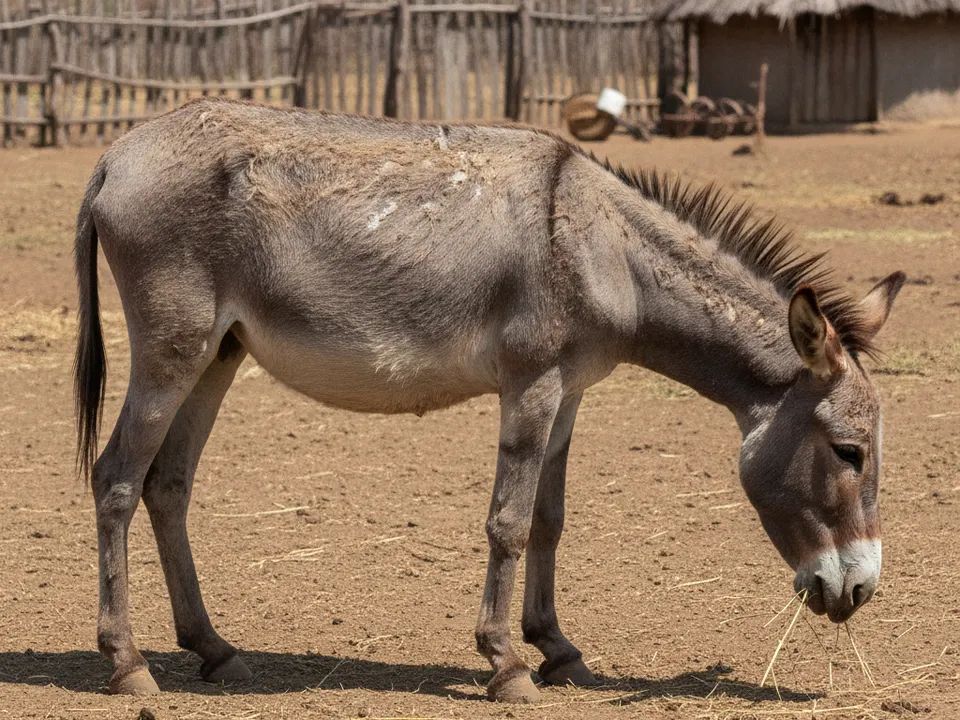
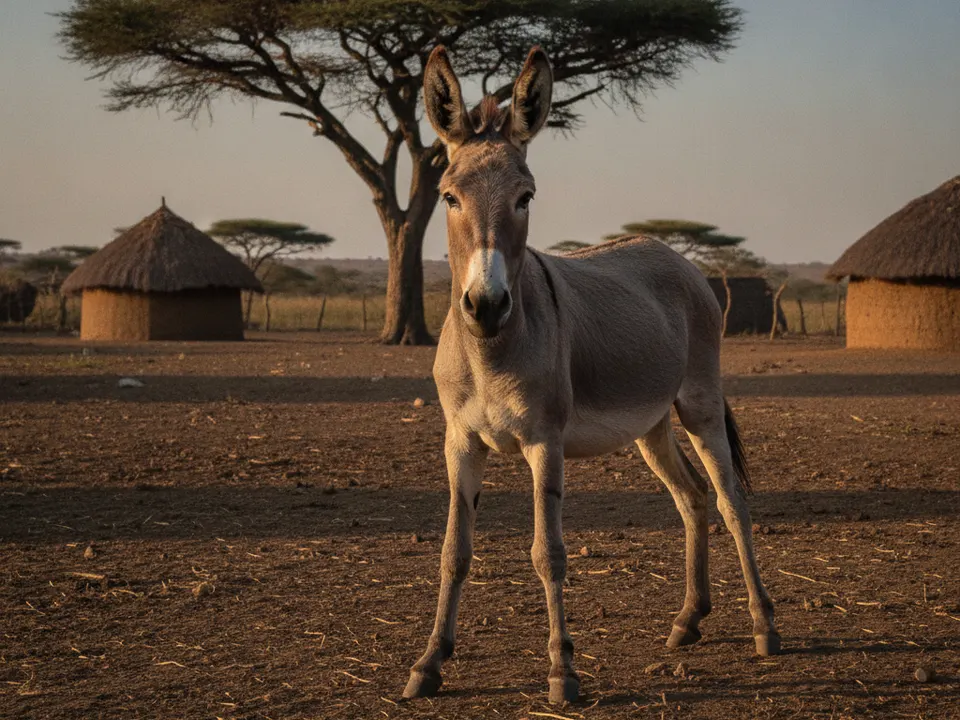
Any unvaccinated donkey of any age can get tetanus, and most donkeys in Kenya and East Africa have never been vaccinated. Working donkeys that pull carts, carry water, firewood or produce on rough roads are at high risk because they often get hoof punctures, harness sores and other injuries. Young males being castrated, newborn foals and jennies that have just foaled are especially vulnerable. Donkeys kept in yards or sheds with heavy dung build-up, near cattle bomas, or on land with scrap metal, nails and broken wire face more spore contact. Risk rises in the rains when ground is muddy and hooves soften, making punctures easier, and in dry seasons when thorny bush causes many small wounds. Pastoral and peri-urban donkeys that are rarely checked or handled may have wounds that nobody notices.
Signs to look for
Early signs
- Stiffness when walking, short steps, or reluctance to move or turn, which farmers often mistake for tiredness or sore feet.
- The tail head is raised and the tail held slightly out from the body instead of hanging loosely.
- Ears held stiffly upright and pointing back, nostrils flared and a worried, fixed facial expression.
- The third eyelid (a pale membrane in the inner corner of the eye) flicks across the eye when the head is lifted or the donkey is startled by a noise or a clap.
- Difficulty chewing, dropping feed, food balls in the cheeks, or eating very slowly; donkeys are stoic, so a quiet donkey off its feed should always be checked.
- Over-reaction to noise, light or touch, with sudden jerky movements or twitching when approached.
As it gets worse
- The classic 'sawhorse' stance, with all four legs stiff and stretched out and the neck held straight out.
- Locked jaw (lockjaw), where the mouth can hardly be opened, with drooling and inability to eat or drink.
- Strong muscle spasms that look like fits, often set off by noise, light or touch, sometimes with sweating.
- Hard, board-like muscles over the neck, back, belly and legs.
- Falling over and being unable to get up, with the legs held rigid; a donkey that goes down usually has a very poor outlook.
- Difficulty breathing, high body temperature from the constant muscle work, constipation and inability to pass urine, followed by death if untreated.
What to do right now
- Call a vet straight away and describe the stiffness, raised tail, eye signs and jaw problems, because tetanus gets worse quickly and antitoxin works best early.
- Move the donkey calmly to a quiet, dark, shaded and well-bedded shed or corner, away from children, dogs, radios, traffic and other noise that can trigger spasms.
- Stop all work immediately; do not try to walk, ride or pull the donkey further than needed, and never beat or force it to move.
- Place water and soft, wet feed (such as soaked hay or mash) at a height the donkey can reach without bending its stiff neck, but do not force food or liquid into its mouth, as it may choke or inhale it into the lungs.
- Check the hooves and body for wounds, nails or thorns, but leave deep wound cleaning and opening to the vet, and note any wounds you find.
- Protect yourself and others: a donkey in spasm can fall or kick suddenly, so approach slowly, keep children away and stand to the side, not behind or in front.
- If the donkey goes down, give thick soft bedding and pad the head to prevent injury, and wait for the vet rather than trying to lift it alone.
- Do not give any medicines, injections or home remedies without the vet's advice, and write down when signs started and what you have seen.
How it spreads
- Deep puncture wounds are the classic entry point, especially nails, thorns, wire or sharp sticks that go into the sole of the hoof and are often never noticed.
- Castration wounds, particularly when done without clean instruments or without tetanus cover, are a common cause in young male donkeys.
- Harness, saddle and cart sores, rope burns and wounds from beatings or sticks can let spores in, especially when dung and dust get into the wound.
- Newborn foals can be infected through the wet navel stump if they are born on dirty ground or in a dung-filled shed.
- Jennies (female donkeys) can be infected after a difficult foaling, through tears in the birth canal or a retained afterbirth.
- Other routes include dental problems, ear or skin injuries, dirty injection sites and bite wounds from dogs or other donkeys.
- Tetanus does not spread directly from one donkey to another; each case comes from spores in the environment entering a wound.
Could it be something else?
Laminitis (founder)
A donkey with laminitis also stands strangely, but it rocks its weight back onto the heels to take pressure off painful front feet, and the hooves feel hot with a strong pulse above them. It can open its mouth and eat normally, the third eyelid does not flash, and the tail is not held stiffly out.
Rabies
Rabies usually causes changes in behaviour, such as aggression, unusual biting, depression, paralysis or a strange bray, rather than the rigid, locked muscles of tetanus. Rabies is a deadly notifiable disease that infects people, so if there is any chance of rabies, do not put your hand in the mouth, keep people away and report it to the County Veterinary Officer at once.
Lactation tetany (low blood calcium)
This mainly affects jennies nursing a foal or heavily worked animals, and causes trembling, stiffness and sometimes a fast 'thumping' heartbeat. There is usually no wound history, the third eyelid flashing is less typical, and a vet will see quick improvement after calcium treatment.
Colic or hyperlipaemia
Donkeys with colic or hyperlipaemia (a dangerous fat build-up in the blood seen in stressed, off-feed donkeys) are dull, stop eating and may lie down or roll, but their muscles are not locked rigid and they do not over-react to sound. All of these are emergencies, so call the vet either way.
How it is diagnosed
There is no quick farm or lab test for tetanus, so a vet diagnoses it mainly from the signs and the history. The vet will watch the donkey's stance and movement, check for third eyelid flashing by gently lifting the chin or making a sudden noise, test whether the jaw can be opened, and feel the muscles. They will look carefully for a wound, especially on the soles of the hooves, the castration site, the navel of foals, harness areas and the mouth. Blood tests may be used to rule out other problems such as low calcium or hyperlipaemia. If an animal dies, a post-mortem may be done mainly to rule out other causes, as tetanus leaves few clear changes. To help the vet, note when you first saw stiffness, any recent wounds, castration, foaling or injections, whether the donkey was ever vaccinated against tetanus, and whether it is still drinking and passing dung and urine.
Treatment
Treatment of tetanus in donkeys is difficult, slow and costly, and even with good care many animals die, so the vet will give an honest view of the chances before starting. Treatment usually aims at four things. First, the vet gives tetanus antitoxin, which neutralises toxin that is still circulating, though it cannot undo toxin already bound to the nerves. Second, antibiotics such as penicillin or metronidazole are used to kill the bacteria still producing toxin, and the vet will open, clean and flush the wound to let air in. Third, sedatives and muscle relaxants are used to calm the donkey and reduce painful spasms, together with a dark, quiet stable. Fourth, supportive care keeps the animal alive while the nerves recover: fluids and liquid feed may be given by stomach tube or drip if it cannot drink, the donkey may be supported in a sling, and the vet may need to help it pass urine and dung. Vaccination with tetanus toxoid is often started at the same time, because surviving tetanus does not give lasting immunity. Recovery, if it happens, takes weeks, and stiffness may slowly ease over a month or more. All medicines must be prescribed and given by a vet; do not buy antibiotics from an agrovet and treat on your own, because wrong use breeds antibiotic resistance and does not neutralise the toxin. If donkey milk or meat is ever used for food, the drug withdrawal periods the vet gives must be followed. Antitoxin is made from horse serum and can rarely cause reactions, which the vet will watch for.
Medicines must be prescribed and dosed by a vet. Always respect milk and meat withdrawal periods, and finish the full course of any antibiotic.
Prevention
- Vaccinate every donkey against tetanus with tetanus toxoid: a primary course followed by regular boosters on the schedule your vet advises; equine tetanus vaccines are commonly used in donkeys.
- Vaccinate pregnant jennies in late pregnancy as your vet advises, so that their first milk (colostrum) gives the newborn foal protection, and plan foal vaccination with the vet.
- When an unvaccinated donkey gets a deep wound, ask the vet promptly about tetanus antitoxin and starting vaccination, rather than waiting to see if signs appear.
- Have castration done only by a vet or trained animal health worker using clean instruments, with tetanus protection given beforehand.
- Keep foaling areas clean and dry, and dip the newborn foal's navel in a suitable disinfectant soon after birth.
- Check hooves daily, especially in the rains, remove stones and thorns, and have the hooves trimmed regularly so cracks and punctures are found early.
- Fit harnesses, saddles and cart shafts well, pad them, and check for sores every day; rest donkeys with sores until they heal.
- Clear yards, sheds and paths of nails, wire, broken glass and scrap metal, and remove dung build-up regularly to reduce spore numbers.
Risk to people
People cannot catch tetanus from a sick donkey, but they can get tetanus in the same way donkeys do, from soil, dust and dung entering cuts, thorn pricks and nail wounds. Farmers, carters and children who work around donkeys and manure are at risk. Make sure everyone in the household is up to date with tetanus vaccination at the local health facility, wear shoes and gloves when cleaning sheds and handling wounds, and clean any cut promptly and seek medical advice for deep or dirty wounds. A donkey in tetanus spasm can also kick or fall suddenly, so handle it carefully to avoid injury.
Impact on your farm
In Kenya, donkeys are working animals that carry water, firewood, farm produce and goods to market, and many families, especially women, depend on them for daily income and to reduce heavy workloads. Losing a donkey to tetanus means lost transport income, more hours spent fetching water by hand, and the cost of buying a replacement. Treatment, when attempted, needs repeated vet visits, medicines and weeks of nursing, and the donkey cannot work during that time. Because the disease is often fatal even with treatment, the money spent may not save the animal. A cheap vaccine given in advance is far less costly than one case of tetanus, which makes vaccination one of the best investments a donkey owner can make.
Outlook and recovery
The outlook for a donkey with tetanus is guarded to poor. Donkeys that are treated early, while they can still stand, drink and swallow, and whose signs develop slowly, have the best chance. Animals that go down, cannot drink, have severe spasms or develop signs very quickly after an injury usually die despite treatment. Survivors often begin to improve after the first week or two, and may need several weeks or more to recover fully, but many go back to normal work. Recovery does not protect the donkey in future, so it must be vaccinated afterwards.
Common questions
Can my other donkeys catch tetanus from the sick one?
No. Tetanus does not pass from animal to animal. Each case comes from spores in soil or dung entering a wound. However, if one donkey got tetanus, the others share the same environment and risks, so this is a good time to vaccinate all of them and check them for wounds.
The wound healed long ago. Can it still be tetanus?
Yes. Signs usually appear one to three weeks after the injury, and sometimes later, so the wound may have healed or been too small to notice, such as a nail prick in the hoof. Tell the vet about any wounds, castration or foaling in the past weeks, even if they look healed.
Will antibiotics from the agrovet cure tetanus?
No, not on their own. Antibiotics can kill the bacteria, but the damage comes from the toxin already attached to the nerves. A vet needs to give antitoxin, clean the wound, control spasms and give supportive care. Using antibiotics without a vet wastes money, delays proper treatment and adds to antibiotic resistance.
Is there a vaccine for donkeys, and is it expensive?
Yes. Tetanus toxoid vaccines, often the ones made for horses, are used in donkeys and are usually affordable compared to the cost of losing an animal. A donkey needs a first course and then regular boosters. Ask your vet, County Veterinary Officer or a donkey welfare organisation about vaccination; some run vaccination days in donkey-working areas.
If my donkey survives tetanus, is it protected for life?
No. The amount of toxin that causes disease is too small to build lasting immunity, so a donkey that recovers can get tetanus again. It needs to be vaccinated once it is well enough, as your vet advises.
My donkey is stiff but still eating. Should I wait and see?
No. If you see stiffness together with a raised tail, pricked ears, flashing third eyelid or slow chewing, call the vet now. Tetanus usually gets worse over a few days, and treatment works best before the donkey stops drinking or goes down. Laminitis and other problems can also look like stiffness, and they also need a vet.
A guide, not a diagnosis. This page is general information to help you recognise problems early. Always confirm with a vet or animal health worker before treating.