What it is
The disease is caused by several species of Eimeria, which are protozoa (microscopic single-celled parasites, not worms and not bacteria). Each Eimeria species infects only one kind of animal, so the types that attack rabbits do not infect chickens, goats or people, and the chicken types do not infect rabbits. There are two main forms. In the intestinal form, several species, including Eimeria flavescens and Eimeria intestinalis, which are among the most harmful, invade the lining of the small intestine, caecum and large intestine. They multiply inside the gut cells and burst out, destroying the lining. The damaged gut cannot absorb food and water well, so the rabbit gets diarrhoea, loses fluids and wastes away, and harmful gut bacteria can take over and make things worse. In the liver form, Eimeria stiedae travels from the gut to the liver and multiplies in the bile ducts, the small tubes that carry bile from the liver. The bile ducts swell and become blocked, the liver enlarges, and the belly swells. Liver-form rabbits may look only slightly ill but grow very poorly, and heavy infections can kill. Many rabbits carry mixed infections of both forms at the same time.
Which animals are most at risk
Young rabbits from weaning to about three months of age are most at risk, with the worst losses usually seen a few weeks after weaning, when they lose the protection of their mother's milk and are stressed by separation and new feed. Adult rabbits are usually partly immune and often show no signs, but they keep shedding oocysts and infecting the young ones; does that are pregnant, nursing, old or sick can still become ill. All breeds are affected, including New Zealand White, California, Chinchilla, Flemish Giant and local crosses. Risk is highest in rabbitries with solid wooden floors, rabbits kept on the ground or in deep litter, overcrowded cages, feeding on the floor, and poor cleaning routines. Outbreaks are often more common during the long and short rains, when damp, warm conditions help oocysts mature and survive. Growing meat-rabbit enterprises with frequent batches of weaners are especially affected if cages are not cleaned between batches.
Signs to look for
Early signs
- Young rabbits eat less than usual and stop gaining weight, so they look smaller than litter mates of the same age.
- The coat becomes dull, rough and stary instead of smooth and shiny.
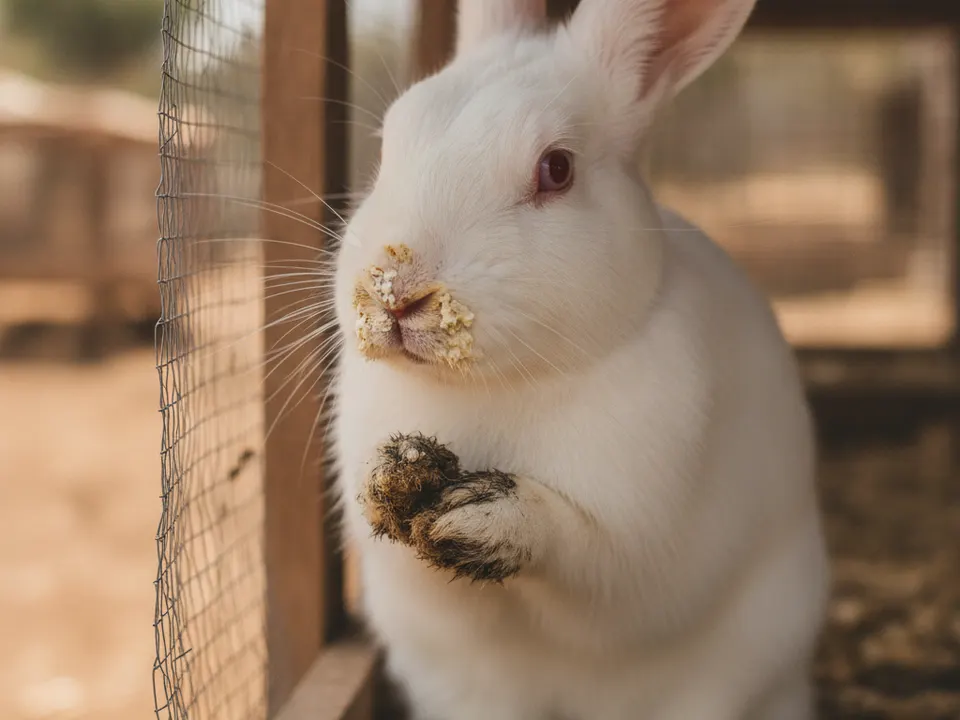
- Droppings become softer, pasty or clumped together instead of firm, round, separate pellets, and may contain mucus.
- Soiling of the fur around the tail and hind legs with soft droppings.
- Rabbits are quieter than normal, sit hunched in a corner and are slower to come to the feeder.
- The belly starts to look fuller or rounder than normal while the back and hips feel thin when you run your hand along them.
As it gets worse
- Watery or mucus-covered diarrhoea, sometimes with streaks of blood, and a strong sour smell in the cage.
- A clearly swollen pot belly, especially in the liver form, while the spine and hip bones stick out.
- Severe weight loss and wasting, with sunken eyes and skin that stays tented when gently pinched, showing dehydration.
- Grinding of teeth, which often signals pain, and refusal of all feed and water.
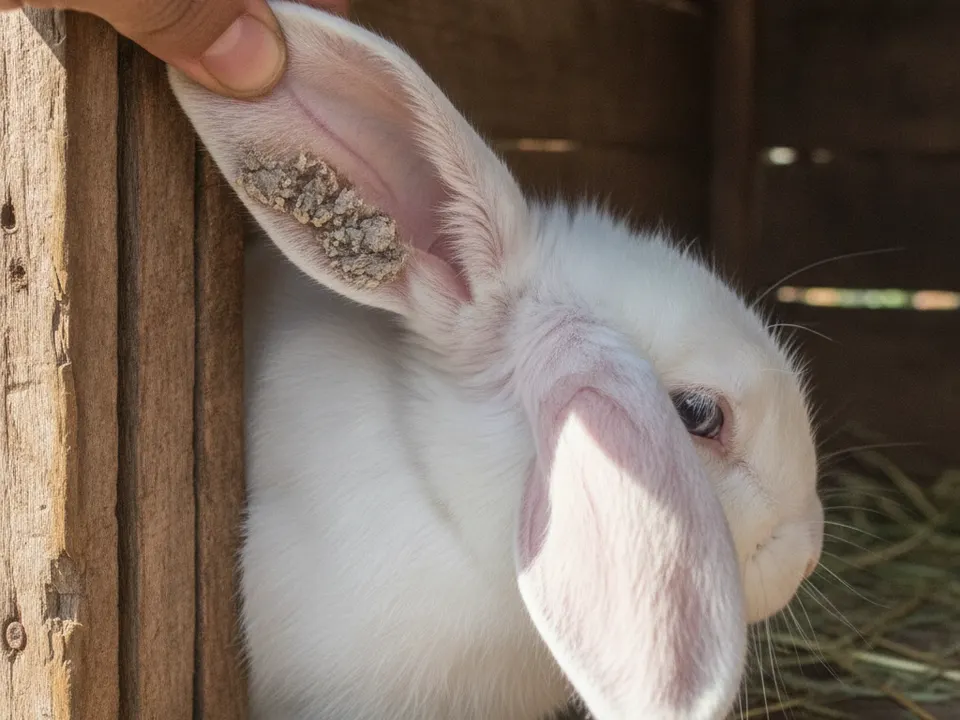
- In the liver form, the whites of the eyes or inside of the ears may look yellowish (jaundice), and the rabbit becomes weak.
- Rabbits lying stretched out or on their side, too weak to move, sometimes with paddling or fits shortly before death.
- Deaths of several young rabbits over days to weeks, often while older rabbits in the same unit look healthy.
What to do right now
- Move rabbits with diarrhoea, pot bellies or weakness into a separate clean cage, away from healthy stock, and handle them last.
- Remove all droppings, wet bedding and spilled feed from every cage, tray and floor today, and keep doing this daily, because oocysts become infective within a few days.
- Make sure every rabbit has constant access to clean, fresh drinking water in a clean drinker that droppings cannot fall into, as diarrhoea quickly causes dehydration.
- Feed good-quality hay or dry grass and fresh, clean greens from areas free of rabbit droppings and manure, and avoid sudden changes or large amounts of wet, lush feed.
- Never put feed or greens on the cage floor; use raised racks, hay nets or feeders so food cannot touch droppings.
- Keep sick rabbits warm, dry, out of draughts and out of direct sun, and reduce stress by not moving, mixing or transporting them.
- Wash your hands after handling sick rabbits and droppings, and clean boots, feeders and tools before going to the healthy cages.
- Record the ages, number sick, number dead and dates, keep a fresh rabbit or droppings sample cool, and call your vet or County Veterinary Officer; do not give any drugs until a vet has confirmed the cause and prescribed treatment.
How it spreads
- Infected rabbits pass huge numbers of microscopic eggs called oocysts in their droppings, often without looking very sick themselves.
- Freshly passed oocysts are not yet infective; they need about one to a few days in warm, damp conditions to mature, which is why droppings left lying in cages, trays and bedding are so dangerous.
- Rabbits become infected by swallowing mature oocysts in feed, greens, hay or water that has touched droppings, for example pellets or grass thrown on a dirty cage floor.
- Wooden or solid-floored hutches where droppings collect, and colony pens on soil, allow oocysts to build up to very high numbers.
- Greens cut from ground where rabbit droppings or manure have been spread, or from around the rabbit house, can carry oocysts into the cage.
- Oocysts survive for months in moist, shaded places and resist many common disinfectants, so a dirty unit can keep infecting batch after batch of young rabbits.
- Stress at weaning, sudden feed changes, overcrowding, transport, heat, cold and wet weather lower resistance and often trigger outbreaks.
- Contaminated equipment, feeders, drinkers, shoes and hands can carry oocysts between cages and between farms, as can newly bought rabbits that are carrying the parasite.
Could it be something else?
Mucoid enteropathy (part of the enteritis complex)
Affected rabbits pass large amounts of clear, jelly-like mucus, often with little or no normal droppings, and the belly may be bloated and sloshing with fluid. Coccidiosis usually causes pasty or watery diarrhoea and slow wasting. The two often occur together, so only a faecal test or post-mortem by a vet can separate them.
Enterotoxaemia (Clostridium infection)
This is a sudden, fast-killing diarrhoea, often brown and watery with a foul smell, frequently after a sudden feed change or too much starchy feed and too little fibre. Rabbits may die within a day or two, sometimes without much diarrhoea at all. Coccidiosis usually builds up more slowly, with weight loss and pot bellies over days to weeks.
Colibacillosis (E. coli diarrhoea)
E. coli often hits very young kits still in the nest, causing yellowish watery diarrhoea and high deaths in whole litters, as well as weaners. Coccidiosis is most common after weaning. A vet needs lab tests to tell them apart, and mixed infections are common.
Tapeworm cysts (Cysticercus pisiformis) and other liver problems
At post-mortem, tapeworm cysts look like small fluid-filled bubbles on the liver surface and in the belly, and come from rabbits eating greens contaminated by dog droppings. Liver coccidiosis shows firm white or cream-coloured spots and swollen tubes inside the liver tissue. Live rabbits with tapeworm cysts often show few signs, so a vet post-mortem is the best way to tell.
How it is diagnosed
A vet usually suspects coccidiosis from the history: young rabbits after weaning, diarrhoea, pot bellies, poor growth and deaths, together with the cage conditions. To confirm it, the vet or lab examines fresh droppings under a microscope using a flotation test, which floats the oocysts up so they can be seen and counted. Because healthy rabbits often carry a few oocysts, the number found and the signs in the animals both matter; a heavy count in sick young rabbits strongly points to coccidiosis. A post-mortem (examination of a dead rabbit) is often the clearest test. In the liver form the liver is enlarged with firm white to yellowish spots and thickened bile ducts, and in the intestinal form the gut wall is thickened, inflamed, sometimes with white spots, and the contents are watery. The lab can also check for other causes such as E. coli, Clostridium or mucoid enteropathy, which often occur alongside coccidiosis. To help, the farmer can collect fresh droppings from several affected rabbits into a clean, sealed container or bag, label it, keep it cool (not frozen) and get it to the vet or lab within a day. A rabbit that has just died should be kept cool in a sealed bag and taken quickly to the vet, the County Veterinary Office or a veterinary laboratory such as those run by the Directorate of Veterinary Services or KALRO. Write down the ages of affected rabbits, when signs started, how many have died, recent feed changes, and any medicines already given.
Treatment
Coccidiosis is caused by a parasite, so ordinary antibiotics alone do not cure it; the vet will prescribe a specific anticoccidial medicine. Commonly used options in rabbits include sulfonamide drugs such as sulfadimethoxine or sulfaquinoxaline, often given in drinking water, and newer anticoccidials such as toltrazuril or diclazuril. Amprolium is also used in some places, though its effect in rabbits varies. Because the whole group is usually exposed, the vet will often recommend treating all rabbits in the affected unit, not only the sick ones. The choice of drug, dose and length of treatment depend on the product, the form of the disease and local availability, so these must be decided by a vet and not guessed from chicken or livestock labels, as some poultry products and doses are unsafe or ineffective in rabbits. Sulfonamides are antimicrobial drugs, so use them only on prescription and finish the course exactly as directed, to slow the development of drug resistance in both parasites and bacteria. If bacteria have also invaded the damaged gut, the vet may add an antibiotic, again only where truly needed. Supportive care is just as important: fluids for dehydrated rabbits, good hay and fibre to restore normal gut movement, warmth and quiet. Very weak rabbits may not survive even with treatment, and liver damage can leave some survivors as poor growers. All drugs used in meat rabbits have withdrawal periods, a set time after the last treatment before the rabbit can be slaughtered for food, so follow the withdrawal time on the label and the vet's instructions. Treatment must be combined with deep cleaning of cages, otherwise rabbits are quickly reinfected.
Medicines must be prescribed and dosed by a vet. Always respect milk and meat withdrawal periods, and finish the full course of any antibiotic.
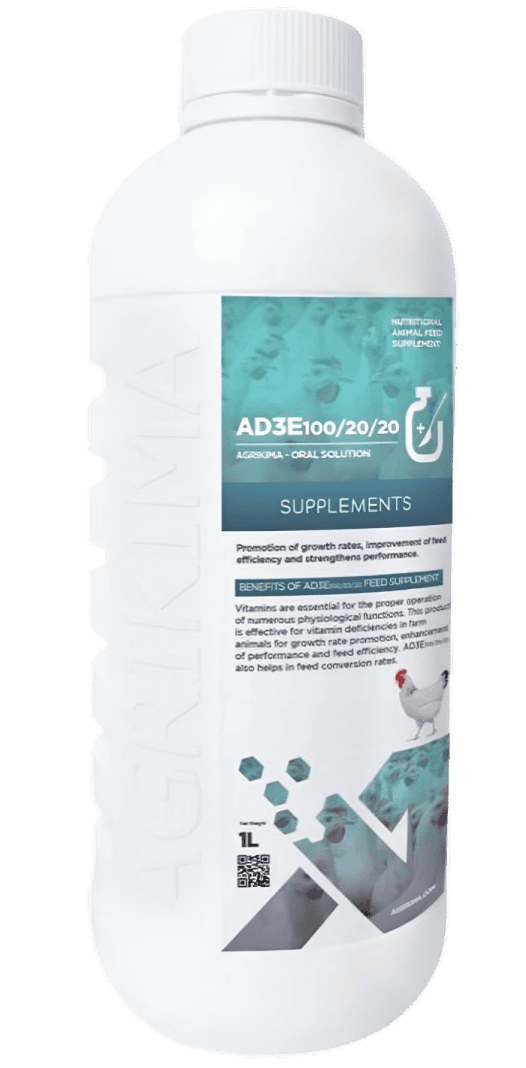
How Agrikima products can help
These support the animal alongside — never instead of — your vet's treatment, vaccination and good management.
Prevention
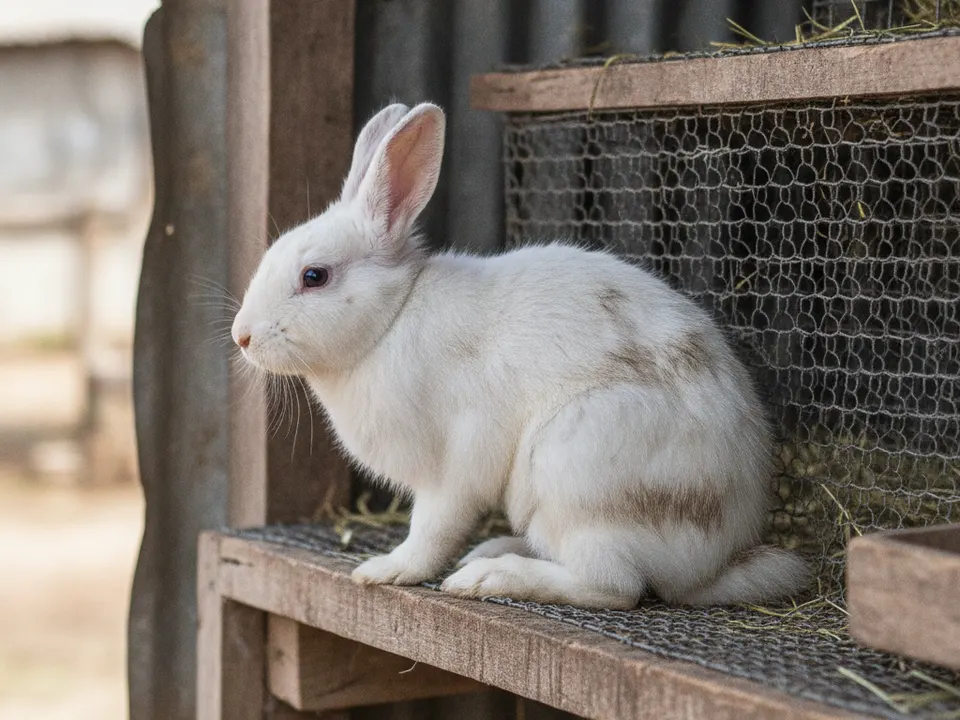
- Keep rabbits in raised cages with wire mesh floors of a suitable size, so droppings fall through and away from the rabbits; if you use wooden hutches, fit mesh floors or removable trays that you clean often.
- Remove droppings from under and inside cages at least daily or every other day, before oocysts have time to mature, and never let manure pile up close to the cages.
- Feed pellets and grains in raised feeders or hoppers and hay in racks, never on the floor, and use drinkers or nipple systems that cannot be soiled with droppings.
- Cut greens from clean areas, not from where rabbit manure is spread or near the rabbit house, and do not let dogs foul the cutting area; let washed greens wilt slightly rather than feeding them soaking wet.
- Between batches, empty cages completely, scrub off all droppings, then use boiling water, a blowlamp on metal mesh, or a disinfectant your vet or agrovet confirms works against coccidia, and let cages dry fully in the sun before restocking; many ordinary disinfectants do not kill oocysts.
- Avoid overcrowding, wean rabbits gradually, keep litters together after weaning where possible, and make feed changes slowly over about a week to reduce stress.
- Feed a balanced diet rich in fibre with enough protein, minerals and vitamins, as well-nourished rabbits resist and recover from coccidiosis better.
- Ask your vet about preventive anticoccidial feeds or planned treatment programmes for weaners on farms with repeated outbreaks, and follow withdrawal periods for meat rabbits.
- Quarantine new rabbits in a separate cage for at least two to three weeks, check their droppings, and buy breeding stock from clean, well-managed rabbitries.
- Keep the rabbit house dry and well ventilated, especially during the long and short rains, and fix leaking roofs and drainage.
Risk to people
The Eimeria parasites that cause rabbit coccidiosis infect only rabbits and are not known to infect people. However, diarrhoeic droppings can carry other germs, so wash your hands with soap after handling sick rabbits, droppings or bedding, and keep children from playing with sick animals. The bigger human-health concern is drug residues: meat from rabbits treated with sulfonamides or other anticoccidials must not be eaten or sold until the withdrawal period on the label or advised by your vet has passed. Do not slaughter visibly sick rabbits for food, and discard livers with white spots or obvious damage.
Impact on your farm
Coccidiosis is one of the biggest hidden costs in Kenyan rabbit farming. Deaths of weaners after weaning can wipe out much of a batch in badly affected units, but even rabbits that survive often grow slowly and reach market weight weeks late, eating feed without giving a good return. Liver-form rabbits may look acceptable but have damaged livers that are condemned at slaughter, and thin carcasses fetch lower prices from buyers, hotels and butcheries. Farmers spend money on medicines, vet visits and extra labour for cleaning. Repeated outbreaks can make a rabbit enterprise look unprofitable and discourage new farmers who started with breeding stock and cages. Breeding units that sell weaners can lose their reputation if buyers' rabbits fall sick soon after purchase. On the positive side, most of these losses can be prevented with good cage design and hygiene, which cost far less than repeated deaths.
Outlook and recovery
The outlook depends on how early the disease is caught, how heavy the infection is, and how quickly the environment is cleaned. Rabbits treated in the early stages, while still eating and drinking, often recover well, and the rest of the group can be protected by vet-guided treatment and strict hygiene. Rabbits that are already severely dehydrated, refusing food or lying on their side have a poor chance even with treatment. Survivors of heavy liver infections may remain poor growers because of liver damage, and some are better culled than kept for breeding. Recovered rabbits develop some immunity to the species that infected them, but they can still carry and shed oocysts, so prevention must continue. Farms that fix floors, feeding and cleaning routines usually see far fewer and milder outbreaks.
Common questions
My adult rabbits look healthy. Why do only the young ones get sick and die?
Adult rabbits have usually met the parasite before and built up partial immunity, so they often show no signs. But they still pass oocysts in their droppings. Young rabbits after weaning have no immunity yet, are stressed by weaning and new feed, and swallow oocysts from the cage, so they get the full disease. That is why cleaning and good cage design matter most around weaning time.
Can I use the coccidiosis medicine I bought for my chickens?
Do not do this without asking a vet. The coccidia in chickens are different species from those in rabbits, and some poultry products or the doses on poultry labels are not suitable or safe for rabbits. Some drugs that work in chickens work poorly in rabbits. Your vet will choose a product and dose that is right for rabbits and tell you the meat withdrawal period.
Will antibiotics cure coccidiosis?
Ordinary antibiotics do not kill the coccidia parasite. The medicines that work are anticoccidials, and some of these, such as sulfonamides, also happen to be antimicrobials. A vet may sometimes add an antibiotic if bacteria have invaded the damaged gut. Using antibiotics without a proper diagnosis wastes money, can upset the rabbit's delicate gut and helps drug resistance develop.
Rabbits eat their own soft droppings at night. Does that spread the disease?
Rabbits naturally eat special soft droppings called caecotrophs straight from the bottom; this is normal and needed for good digestion. Newly passed oocysts are not yet infective, so this habit is not the main problem. The danger comes from ordinary droppings left lying in the cage for a day or more, where the oocysts mature and then get onto feed, greens and drinkers. Removing droppings regularly breaks this cycle.
Is it safe to eat rabbits from a group that had coccidiosis?
Rabbit coccidiosis does not infect people. Rabbits that are healthy and well-grown at slaughter can be eaten, but only after the withdrawal period of any medicine they were given has fully passed. Do not slaughter sick or wasted rabbits for food, and throw away any liver with white spots or swollen ducts, which is a sign of liver coccidiosis.
How do I clean cages properly after an outbreak?
First remove all rabbits, droppings, bedding and leftover feed. Scrub every surface with water and soap or detergent to remove dirt, because disinfectants do not work through dirt. Oocysts resist many common disinfectants, so use boiling water, carefully flame metal wire mesh with a blowlamp, or use a product your vet or agrovet confirms kills coccidia. Clean feeders and drinkers the same way, then let everything dry fully in the sun before bringing rabbits back.
A guide, not a diagnosis. This page is general information to help you recognise problems early. Always confirm with a vet or animal health worker before treating.