What it is
Mastitis is caused by bacteria getting into the teat or breast tissue. The most common culprit is Staphylococcus aureus, a bacterium that lives on skin and in the environment; some strains are very aggressive and cause the severe 'blue breast' form. Pasteurella multocida, Streptococcus species, E. coli and Klebsiella are also found. Bacteria usually enter through small wounds on the teats made by the kits' sharp teeth, scratches from wire floors or rough nest boxes, or through dirty, wet bedding. Milk building up in the glands also helps infection take hold, which happens when a doe has more milk than her kits drink, when a litter dies, or when kits are weaned suddenly. Once inside, the bacteria multiply in the warm, milk-filled tissue. The body sends blood and fluid to fight them, causing heat, redness and swelling. In severe cases bacterial toxins kill the tissue and cut off its blood supply, so the skin turns blue or black (gangrene, meaning dead tissue). Toxins and bacteria can then enter the bloodstream (septicaemia, or blood poisoning), which causes high fever, collapse and death.
Which animals are most at risk
Nursing does in the first three weeks after kindling are most at risk, and again around weaning when milk builds up. Heavy-milking meat breeds commonly kept in Kenya, such as New Zealand White, California and Flemish Giant crosses, are often affected. Does with very small litters or whose litters have died, does on wire floors without a resting board, and does kept in crowded, damp or poorly cleaned hutches face higher risk. The long and short rains bring wet bedding and damp hutches, which raises bacterial loads. Rabbitries that foster kits freely between does, or that bring in new stock without quarantine, can see repeated cases. Older does that have had mastitis before, and unspayed older does with breast changes, may also have problems.
Signs to look for
Early signs
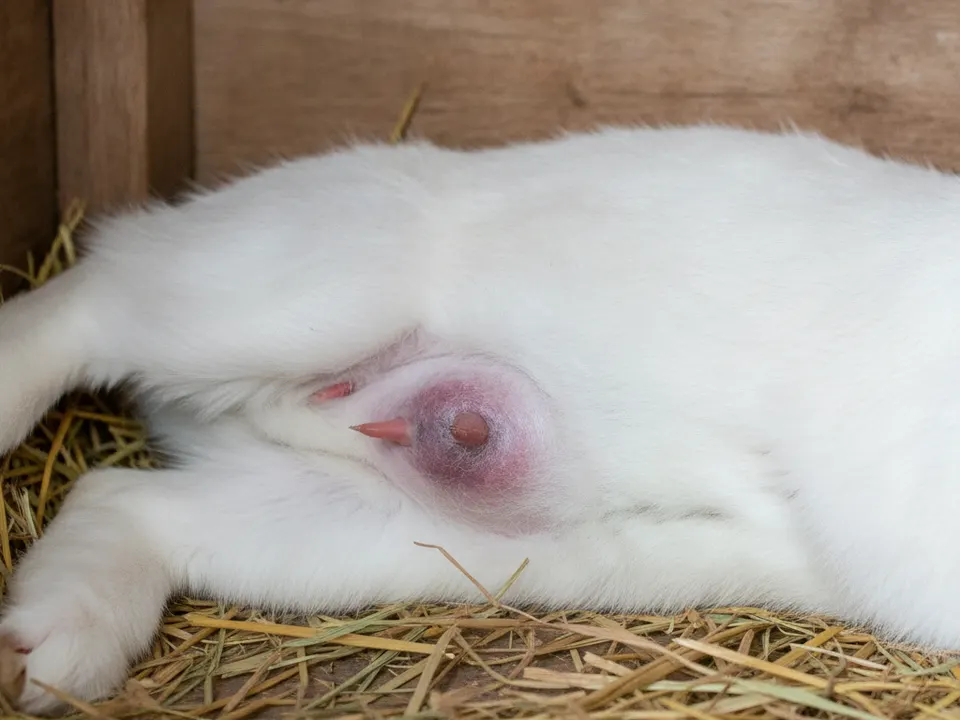
- One or more teats look pink to red and feel warmer than the others when you gently touch the belly.
- The breast tissue around a teat feels firm, lumpy or swollen instead of soft.
- The doe flinches, grunts or moves away when touched on the belly, and may stop sitting over the nest to feed her kits.
- She eats less than usual, leaves pellets or greens uneaten and drinks less.
- The kits look less full: bellies are flat rather than round and white with milk, and they may cry or crawl about the nest.
- The doe may sit hunched and quiet in a corner more than normal.
As it gets worse
- Teats and breasts turn dark red, purple, blue or black and may feel cold in the centre where tissue is dying.
- The swelling becomes large, hard and very hot, and may spread across several glands.
- Pus or thick, discoloured, bloody or watery fluid may come from the teat, or an abscess (pus-filled lump) forms and bursts.
- The doe stops eating and drinking completely, her droppings become small or stop, and she breathes fast.
- She becomes very weak, lies flat, feels hot to touch or later cold as she goes into shock.
- Kits become thin, wrinkled, dehydrated and weak, and some die in the nest; surviving kits may develop skin abscesses or infections themselves.
- Sudden death of the doe can happen within one to two days in the severe blue-breast form.
What to do right now
- Move the sick doe and her kits into a clean, dry, quiet hutch away from other nursing does, ideally with a solid resting board over any wire floor.
- Do not foster her kits onto another doe without a vet's advice, because the kits can carry the bacteria and give mastitis to a healthy doe.
- Wash your hands with soap and water before and after touching her, wear disposable gloves if you have them, and handle her last after all healthy rabbits.
- Offer fresh clean water in a bowl as well as the drinker, plus her favourite fresh greens such as clean sukuma wiki leaves, grasses or hay, to tempt her to keep eating.
- Check the kits several times a day: note whether their bellies are full, whether they are warm, and how many are alive, and keep the nest clean, dry and warm.
- Replace soiled nest material with clean, dry hay or wood shavings and remove anything sharp or rough in the hutch that could scratch her teats.
- Do not try to squeeze out a hard, blue or black gland or cut into a lump, as this can push infection into the blood and is very painful.
- Record her temperature if you have a thermometer and are confident using it, along with appetite and droppings, then call your vet or the County Veterinary Office the same day.
How it spreads
- Kits suckling on an infected doe can carry bacteria in their mouths and on their faces, so fostering those kits onto a healthy doe can spread mastitis to her.
- Farmers' hands carry bacteria from one doe to the next when checking nests or handling litters without washing in between.
- Dirty, damp or soiled nest material and bedding hold large numbers of bacteria that enter small cuts on the teats.
- Sharp wire, broken hutch floors, rough nest-box edges and splinters scratch the teats and let bacteria in.
- Kits with sharp teeth, especially large litters fighting for too few teats, nick and bruise the teats.
- Milk build-up after a litter dies, after sudden weaning, or when a doe has a very small litter makes the glands an easy target for infection.
- Shared equipment such as nest boxes and feeders that are not cleaned between litters keep the bacteria in the rabbitry.
Could it be something else?
Caked breasts (milk stasis)
Milk simply builds up when kits die, are weaned suddenly or the litter is small. The glands are full and firm but usually not very hot, red or blue, and the doe keeps eating and has no fever. Caked breasts can turn into mastitis if not managed, so watch closely and ask a vet if in doubt.
Abscess on the belly or chest
An abscess is a single, round, well-defined lump of pus, often caused by Pasteurella, and it can appear at any time, not just after kindling. Mastitis involves the milk glands themselves, starts around the teats and usually makes a nursing doe sick quickly.
Mammary tumours or cystic breasts
These are seen mostly in older does that are not used for breeding or have had many litters. Lumps grow slowly over weeks or months, are usually not hot or painful, and the doe stays bright and eating.
Moist dermatitis (sore, wet skin)
Skin on the belly, dewlap or between the legs is wet, red and smelly from urine, drooling or damp bedding, but the breast tissue under it is soft and not swollen. The doe is usually not feverish.
How it is diagnosed
A vet diagnoses mastitis mainly by examining the doe: looking at and feeling each mammary gland, checking colour, heat, swelling and any discharge, and taking her temperature, because a fever supports infection. The vet will also check her hydration, gut sounds and droppings, since a doe that stops eating can develop gut stasis (the gut slowing or stopping), and will examine the kits. Where there are repeated cases on a farm, the vet may take a sample of milk or pus to a laboratory for culture, which identifies the bacteria, and a sensitivity test, which shows which antibiotics will work. This is very useful in Kenya where some bacteria are resistant to common drugs. If a doe dies, a post-mortem by a vet or county veterinary laboratory can confirm the cause and protect the rest of the herd. Before the vet arrives, write down when the doe kindled, litter size, when you first saw signs, what she has eaten, any kits that died, and whether any kits were fostered. Keep the doe in a clean box so the vet can see the glands clearly, and do not apply creams or home remedies that hide the signs.
Treatment
Treatment must be prescribed by a vet, and rabbits need special care because many common antibiotics are dangerous to them. Some drugs, especially penicillins and related drugs given by mouth, lincomycin and clindamycin, can upset the rabbit's gut bacteria and cause fatal diarrhoea. A vet will choose an antibiotic that is safer for rabbits and suits the likely bacteria; drug groups often used include fluoroquinolones such as enrofloxacin, potentiated sulphonamides such as trimethoprim-sulfa, and in some cases carefully chosen injectable antibiotics. Where possible a culture and sensitivity test guides the choice. The vet will usually give a pain-relieving anti-inflammatory drug, because pain stops the doe eating, and may give fluids if she is dehydrated. Warm compresses may be advised for early, hard glands. Abscesses may need to be lanced and flushed, and in the severe gangrenous form dead tissue may have to be surgically removed, which is not always possible. The vet will also advise on the kits: whether they can keep nursing, need hand-feeding, or can be fostered safely, and young kits that lose their mother's milk are hard to raise. Complete the full course of any antibiotic exactly as prescribed, never share leftover drugs with other rabbits, and respect the meat withdrawal period the vet gives before any treated rabbit is slaughtered. Using the wrong antibiotic, stopping early or treating without a vet helps create antimicrobial resistance, meaning bacteria that drugs can no longer kill, which harms animals and people. Expect improvement in early cases within a few days; severe cases may not survive even with good treatment.
Medicines must be prescribed and dosed by a vet. Always respect milk and meat withdrawal periods, and finish the full course of any antibiotic.
Prevention
- Keep hutches and nest boxes clean and dry, change nest bedding when it is soiled or damp, and clean and disinfect nest boxes between litters.
- Remove sharp wire ends, splinters and rough edges, and give does a solid resting board or mat so their teats do not rub on wire floors.
- Wash hands between handling different does and litters, and check healthy does before any sick one.
- Check the doe's belly gently every day or two in the first three weeks after kindling so you catch redness or firmness early.
- Balance litter size: avoid leaving a high-milking doe with only one or two kits, and when fostering is needed, only foster healthy kits between healthy does of similar kindling dates.
- Wean gradually over several days rather than removing all kits at once, and reduce concentrate feeding slightly around weaning to help milk production slow down.
- Never foster kits from a doe with mastitis onto another doe, and cull or stop breeding does that suffer repeated or severe mastitis, as they often relapse and spread bacteria.
- Quarantine new rabbits for about three to four weeks before mixing them in, and feed a balanced ration with good hay, clean greens and fresh water to keep does strong through lactation.
Risk to people
Staphylococcus aureus and Pasteurella, the bacteria that most often cause rabbit mastitis, can also infect people, usually through cuts, scratches or bites, causing skin infections or painful, swollen wounds. Some Staphylococcus strains are resistant to antibiotics. Wear gloves or wash hands well with soap and water after handling a sick doe, her kits or her bedding, cover any cuts on your hands, and clean scratches promptly. Do not eat rabbits that died of mastitis or slaughter a sick doe for food. Respect the meat withdrawal period given by the vet after any antibiotic treatment so that drug residues do not reach your family or customers. People with weak immune systems, young children and the elderly should avoid handling infected rabbits, and anyone with a red, hot or spreading wound should see a health worker.
Impact on your farm
On a Kenyan smallholder or commercial rabbit farm, mastitis can wipe out a whole litter of six to ten kits through starvation, and a valuable breeding doe may die or have to be culled. Each lost litter means lost meat sales and lost replacement stock, and a doe that recovers may produce less milk in the affected glands next time. Vet visits, drugs and the time spent hand-feeding kits add cost. When the aggressive staphylococcal form gets into a rabbitry, it can cause repeated cases across many does, forcing farmers to cull breeding stock and clean out the whole unit, which sets production back by months. Rabbits treated with antibiotics cannot be sold for meat until the withdrawal period is over.
Outlook and recovery
The outlook depends mostly on how early treatment starts and which bacteria are involved. Does with early, red, firm glands that are treated promptly by a vet often recover, though the affected gland may produce less milk afterwards. Does with blue or black, cold glands, high fever or collapse have a poor outlook and many die despite treatment. A doe that stops eating can also develop gut stasis, which worsens her chances. Kits under about two to three weeks old are at serious risk because they depend fully on milk; older kits that are already eating solid food survive better. Does that recover may get mastitis again in later litters, and repeated cases are a sign to retire her from breeding and review hygiene in the whole rabbitry.
Common questions
Can the kits keep suckling from a doe with mastitis?
It depends on how bad it is, so ask your vet. In mild cases the vet may allow kits to keep nursing from the healthy glands. In severe cases the milk may be infected, the doe may refuse to nurse, and kits can catch skin or other infections, so they may need to be removed. Do not foster them onto another doe without advice, because they can carry the bacteria and start mastitis in her.
Why can't I just give my rabbit the same antibiotic I use for my cows or goats?
Rabbits have a delicate gut full of helpful bacteria. Several antibiotics that are safe in cattle or goats, especially some penicillins and related drugs given by mouth, can kill those helpful bacteria and cause severe, often fatal diarrhoea in rabbits. Doses also differ greatly. Only a vet should choose the drug, and using the wrong one also helps create antibiotic resistance.
My doe's breasts are hard but she is still eating. Is that mastitis?
It may be caked breasts, meaning milk build-up, especially if her litter is small, some kits died or you just weaned them. If the glands are not very hot, red or blue and she is eating and active, it may settle. But caked breasts can quickly become infected, so check her twice a day and call the vet if she goes off feed, the skin changes colour, or the glands get hotter.
Should I keep breeding a doe that has had mastitis?
A doe that had one mild case and recovered fully may breed again, but watch her closely after each kindling. Does that had the severe blue form, lost glands, or get mastitis again are often best retired from breeding, because they are likely to relapse and can carry bacteria that spread to other does.
Can I eat or sell a doe that had mastitis?
Never eat a rabbit that died of mastitis or slaughter one that is visibly sick. If a doe recovers after treatment, she can only be used for meat after the full withdrawal period the vet gives for the drugs used has passed, so that no drug residues are left in the meat.
How do I stop mastitis coming back in my rabbitry?
Focus on cleanliness and comfort: dry, clean nest boxes, resting boards over wire floors, no sharp edges, handwashing between hutches, and daily belly checks after kindling. Wean gradually, avoid tiny litters on heavy-milking does, never foster kits from a sick doe, and retire does with repeated cases. If many does are affected, ask your vet to culture samples so the right drugs and cleaning plan can be used.
A guide, not a diagnosis. This page is general information to help you recognise problems early. Always confirm with a vet or animal health worker before treating.