What it is
All of a rabbit's teeth are open-rooted. This means they keep growing for its whole life, the front teeth by a few millimetres every week. In a healthy rabbit, chewing on rough, fibrous food like grass and hay grinds the teeth down as fast as they grow. Malocclusion happens when this balance breaks. Some rabbits are born with a short upper jaw or a mis-shaped skull, so the front teeth never meet. This is common in dwarf and lop-eared breeds and is passed from parents to young. Other rabbits develop it later. The main cause is a soft diet of pellets, kitchen scraps or soft greens with too little hay. Pellets need only short, crushing bites, not the long side-to-side grinding that wears the cheek teeth. Damage can also start from injury, such as pulling on wire cage bars or a fall that breaks a tooth. Infection, or poor calcium and vitamin D supply affecting bone strength, may play a part, though experts still debate how much. Once the teeth are uneven, the problem builds on itself. The back cheek teeth (molars and premolars) grow sharp points called spurs. These cut the tongue and cheeks, so chewing hurts and the rabbit eats less hay, which makes wear even worse. The roots can also grow longer and push into the jawbone and toward the eye. There they can block the tear duct, which causes eye discharge, and they can lead to tooth-root abscesses, pockets of pus in the jaw.
Which animals are most at risk
Any rabbit can be affected. Some face more risk than others. Dwarf breeds, lop-eared breeds and other rabbits with short, flat faces are most likely to have the inherited form, which often shows in young rabbits from a few weeks to months old. Commercial breeds kept for meat in Kenya, such as New Zealand White, Californian, Chinchilla and Flemish Giant, more often get the acquired form. This happens when they are fed mostly pellets or kitchen waste in cages with little hay. Older rabbits and breeding does kept for several years are at higher risk, because uneven wear builds up over time. Rabbits in wire-mesh hutches with nothing safe to chew are more likely to damage their front teeth. Farms that keep breeding from the same few animals without checking their teeth can see the problem become common in a line.
Signs to look for
Early signs
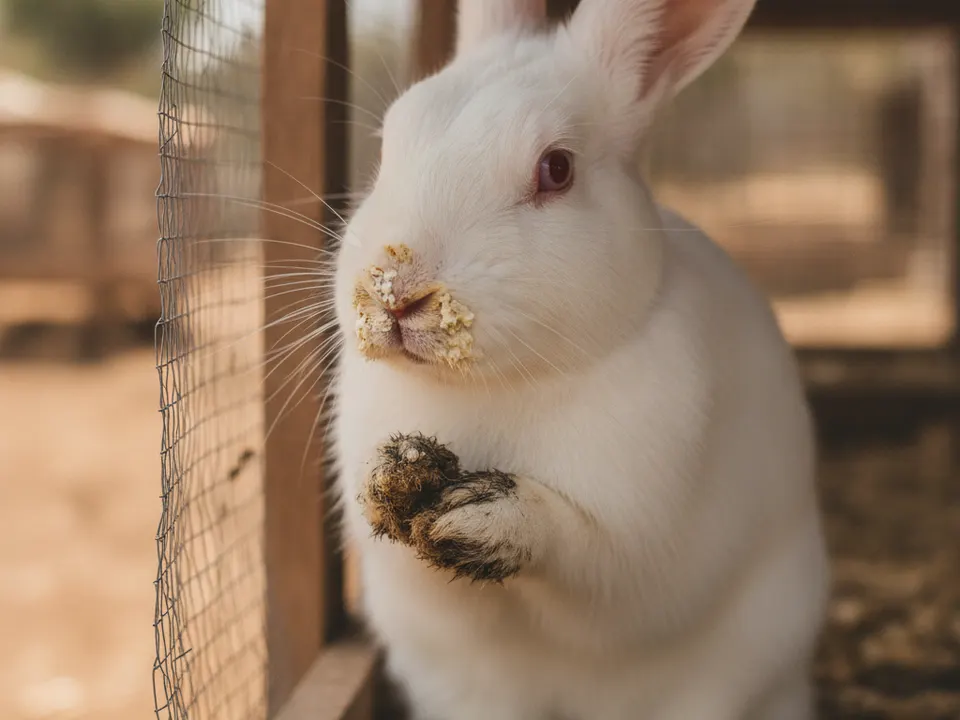
- Wet chin, neck or front legs, with damp or matted fur from drooling (often called 'slobbers').
- Picking up food then dropping it, or chewing slowly or on one side only.
- Choosing soft foods like pellets or soft leaves and leaving hay, grass stems and harder vegetables.
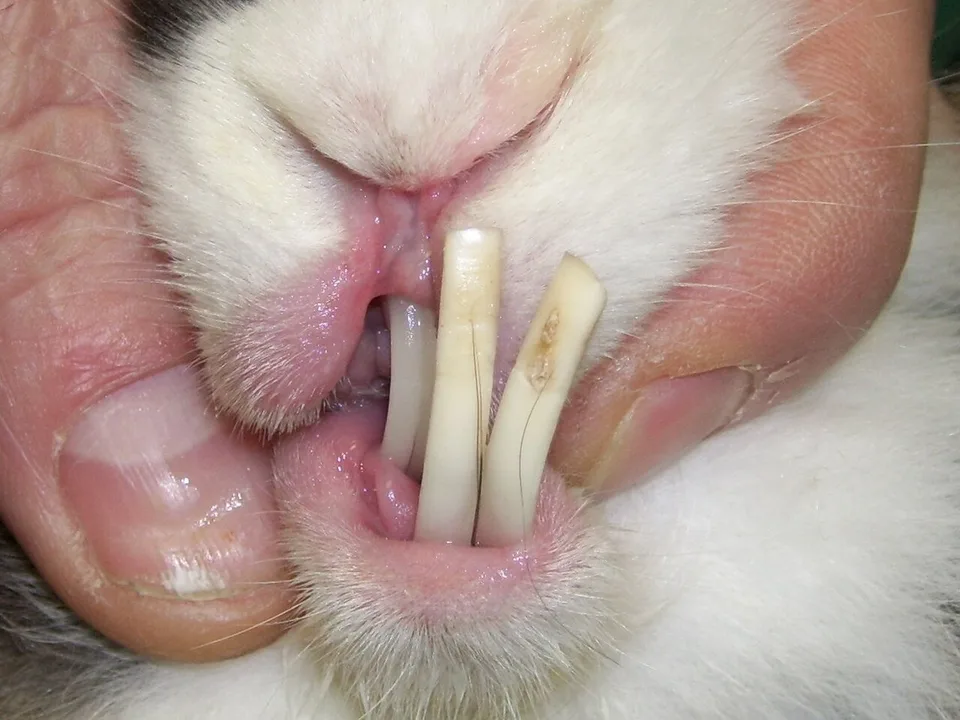
- Front teeth that look too long, curve outward or sideways, or do not meet in a neat line when you lift the lips.
- Small, fewer or misshapen droppings, because the rabbit is eating less fibre.
- Less grooming, so the coat looks rough, and soiled fur around the tail.
- Watery or slightly cloudy discharge from one or both eyes.
As it gets worse
- Clear weight loss: the spine and hip bones feel sharp under your hand.
- Front teeth that curl into the lips, gums or up toward the nose and cause sores.
- A firm or soft lump along the jaw or under the eye, which may be a tooth-root abscess.
- Thick white or yellow eye discharge and a wet, crusted face, with one eye sometimes looking pushed forward.
- Grinding teeth loudly, hunching in a corner, and not wanting to move, all signs of pain.
- Bad smell from the mouth, or blood-tinged saliva.
- Complete refusal of food with few or no droppings. This is an emergency, because the gut can stop working within about a day.
What to do right now
- Handle the rabbit calmly, wrapped in a towel. Gently lift the lips to look at the front teeth and check for sores, then feel along the jaw for lumps.
- Weigh the rabbit and write down the weight, date, what it is eating and the number of droppings. This helps the vet see whether it is getting worse.
- Offer plenty of fresh soft grass, soft leafy greens and hay, all chopped short, so it can keep eating while you wait. Never leave a rabbit without food.
- Give clean water in a shallow bowl as well as any nipple bottle, because a sore mouth makes bottle drinking hard.
- Keep the rabbit in a quiet, shaded, cool spot away from stress. Separate it only if cage-mates are stealing its food or bullying it.
- Gently wipe and dry the wet chin and eye area with a clean damp cloth to prevent skin sores and flies.
- Do not cut the teeth yourself with nail clippers, pliers or wire cutters. This often splits the tooth, exposes the painful centre and lets infection into the root.
- If the rabbit has eaten nothing and made few or no droppings for about 12 hours or more, treat it as an emergency and get to a vet the same day.
How it spreads
- It is not contagious. It cannot pass from one rabbit to another by contact, so cage-mates will not catch it.
- Inherited jaw shape passes from parents to kits, so breeding from an affected buck or doe spreads the problem through your herd.
- A diet low in long fibre is the biggest trigger. Examples are mainly pellets, bread, kitchen leftovers, or soft greens like cabbage and sukuma wiki without enough hay or dry grass.
- Chewing or pulling on wire mesh and cage bars can bend, crack or misalign the front teeth, especially in bored or crowded rabbits.
- Injury from falls, rough handling or fights can break a tooth, so its partner tooth is no longer worn and overgrows.
- Dry seasons, when good grass is scarce and farmers rely more on pellets or scraps, can raise the number of cases a few months later.
- Rabbits kept indoors in dark sheds with no sunlight and a poor mineral balance may have weaker bone around the teeth, though this link is still uncertain.
Could it be something else?
Snuffles (Pasteurella and other respiratory infections)
Snuffles causes sneezing, a runny nose and matted fur on the inside of the front legs from wiping the nose. Eye discharge can occur in both. In snuffles the rabbit usually still chews normally and the teeth look fine. With dental disease the drooling and food dropping are the main signs. The two can also happen together.
Gut stasis (gastrointestinal stasis)
Gut stasis is when the gut slows or stops. The rabbit stops eating, makes few or no droppings and may have a tight, painful belly, but there is usually no drooling or wet chin. It is often caused by dental pain, so a rabbit with stasis should always have its teeth checked.
Coccidiosis
Coccidiosis is caused by a tiny gut or liver parasite. It mainly affects young weaners and causes weight loss, a pot belly and diarrhoea, often in several rabbits at once. Teeth and chin are normal. Dental disease usually affects single rabbits and causes drooling, not diarrhoea.
Heat stress
A heat-stressed rabbit may drool slightly. But it also breathes fast, has hot, red ears, lies stretched out and appears on hot afternoons in tin-roofed hutches. It improves quickly when cooled. Dental drooling continues day after day whatever the weather.
How it is diagnosed
A vet starts by looking at the front teeth and feeling the jaw, face and under the eyes for lumps, heat or pain. The back teeth sit deep in a narrow mouth. The vet checks them with an otoscope (a small lighted viewer) or a mouth speculum, and a full check often needs sedation. X-rays of the skull, where available, show tooth roots, bone damage and abscesses, and help decide whether repeated trimming or removal is better. If there is pus, the vet may take a sample to find the right antibiotic. Before the visit, write down what the rabbit eats each day, when the drooling or food dropping started, and any change in droppings. If you can, weigh it on a kitchen or hanging scale and note the weight. Tell the vet whether its parents or littermates had similar teeth. Bring the rabbit in a secure, well-ventilated box with some hay so the vet can watch it try to eat.
Treatment
Treatment depends on which teeth are affected and how badly. For overgrown front teeth, the vet usually shortens and reshapes them with a dental burr, a small high-speed grinding tool, which is safer than clippers. For spurs on the back teeth, the rabbit normally needs sedation or anaesthesia so the vet can file the sharp points smooth. Because the teeth keep growing, most rabbits need repeat trimming every few weeks to few months for life. If the front teeth will never meet properly, the vet may advise removing them under anaesthesia. Rabbits manage well without front teeth if food is cut into small pieces. Pain relief, commonly a non-steroidal anti-inflammatory drug such as meloxicam, helps the rabbit start eating again. A rabbit that has stopped eating may need syringe feeding with a soft fibre mash and medicines to restart the gut. Tooth-root abscesses are hard to treat. They may need surgery to clean or remove the bad tooth plus a longer antibiotic course. Antibiotics should only be used when there is infection, and only as prescribed, because misuse breeds resistant bacteria (antimicrobial resistance). Some antibiotics are dangerous to rabbits and can kill them by upsetting their gut, so never use leftover livestock drugs. If treated rabbits are meat animals, follow the vet's withdrawal period before slaughter. For commercial meat units where lifelong trimming is not practical, the vet may advise humane culling of badly affected animals. All medicines and doses must be prescribed by a vet.
Medicines must be prescribed and dosed by a vet. Always respect milk and meat withdrawal periods, and finish the full course of any antibiotic.
Prevention
- Feed hay or dry grass as the main food, available all day, making up most of what the rabbit eats. Rhodes grass, Boma Rhodes or good mixed grass hay all work.
- Use pellets as a measured supplement only, not the main diet. Too many pellets fill the rabbit without wearing its teeth.
- Add fresh grass, weeds such as sow thistle (mchunga) and safe leafy browse, plus some vegetables, but do not rely on soft kitchen scraps, bread or ugali.
- Store hay for the dry season after the long and short rains, so rabbits do not switch to a soft diet when grazing is poor.
- Give safe things to chew, such as untreated branches from fruit trees or other non-toxic trees and hard grass stems. These reduce boredom and stop rabbits chewing cage wire.
- Check the teeth of every rabbit every few weeks and at weaning, sale and before breeding. Gently lift the lips and look for neat, even front teeth.
- Do not breed from rabbits with crooked teeth or a short jaw, or from parents that produced affected kits. Cull or keep them only as non-breeders.
- Give a balanced mineral supply through a good-quality ration, and let rabbits have some daylight or sunlight where safe. Avoid extra vitamin D or calcium without vet advice, because too much can harm rabbits.
- Handle rabbits carefully and keep hutches safe from falls to prevent broken teeth and jaw injuries.
Impact on your farm
On a Kenyan rabbit farm, dental disease costs money quietly. Affected rabbits eat less, grow slowly and reach market weight late or not at all. Does with sore mouths lose condition, produce less milk and raise smaller, weaker litters. Repeated vet trimming adds cost that a meat rabbit may not pay back. Abscesses and long-term eye infections can make a rabbit unsellable. Where poor genetics is the cause, the problem can spread through a breeding line and lower the value of breeding stock sold to other farmers. Deaths often come from gut stasis or starvation after a rabbit stops eating. The good news is that the main prevention, plenty of hay or grass, is cheap and also improves gut health and growth across the whole herd.
Outlook and recovery
The outlook depends on the cause and on how early it is caught. Rabbits whose problem comes from diet often do well if the teeth are corrected early and they are moved onto a high-hay diet. Some then need little further trimming. Rabbits born with a mis-shaped jaw usually need lifelong regular trimming or tooth removal. Many still live comfortably if the owner keeps up with care. The outlook is poorer once roots have grown into the jaw or eye area, or when tooth-root abscesses form. These often return and can shorten life. A rabbit that stops eating needs fast help, because gut stasis can kill even when the teeth themselves could have been fixed.
Common questions
Can I just cut my rabbit's long front teeth with nail clippers?
It is not recommended. Clippers crush and split the tooth, which can leave sharp edges, expose the painful pulp inside and let infection reach the root. The tooth also grows back quickly, often even more crooked. A vet uses a dental burr to shorten and shape the tooth safely. If no burr is available, ask the vet what they advise for your area.
My rabbits eat plenty of pellets. Why are their teeth still overgrown?
Pellets are soft and broken up quickly, so rabbits eat them fast with little grinding. Rabbit teeth are designed to wear down on tough grass and hay, chewed with long side-to-side movements for many hours a day. Make hay or dry grass the main food and reduce pellets to a measured amount.
Why does my rabbit have eye discharge if the problem is in its teeth?
The roots of the upper cheek teeth and front teeth sit very close to the tear duct, the small tube that drains tears from the eye to the nose. When roots grow too long, they press on or block this duct. Tears then spill over the face and can become infected. Eye discharge together with drooling or food dropping strongly suggests dental disease.
Should I keep breeding from a doe with crooked teeth if she is a good mother?
It is better not to. If the crooked teeth are inherited, she can pass the problem to her kits and they to theirs. You may end up with many affected rabbits. Keep her as a non-breeder or cull her, and choose breeding stock with clean, even teeth.
Is it better to cull an affected meat rabbit or treat it?
This depends on the rabbit's value, how bad the problem is and what treatment costs in your area. A young meat rabbit with an inherited short jaw will need trimming for life, which is rarely worth it commercially. A valuable breeding animal with a diet-related problem may recover well. Discuss it with your vet. If you cull, do it humanely, and respect any medicine withdrawal period before eating the meat.
How often should I check my rabbits' teeth?
A quick look every few weeks during routine handling is a good habit. Also check at weaning, before sale and before mating. Weighing rabbits regularly also helps, because slow weight loss is often the first clue that a rabbit is struggling to eat.
A guide, not a diagnosis. This page is general information to help you recognise problems early. Always confirm with a vet or animal health worker before treating.